|
When I left off on December 20th, we had just returned on board from a day in Florence. Before I continue from that point though, I'd like to bounce back to Florence for a moment, because some of the photos Pete took are worth sharing. The holidays, among other things, have regrettably kept me from getting back to writing until just now.
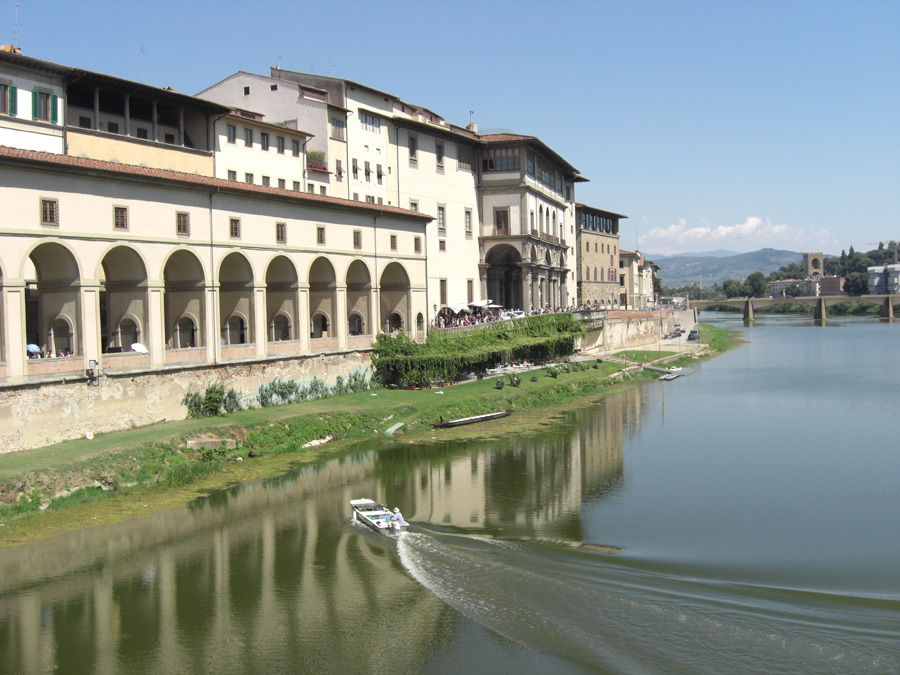
Italy can be so picturesque. Such tranquility can be found in many places all over the world, but Italy seems special.
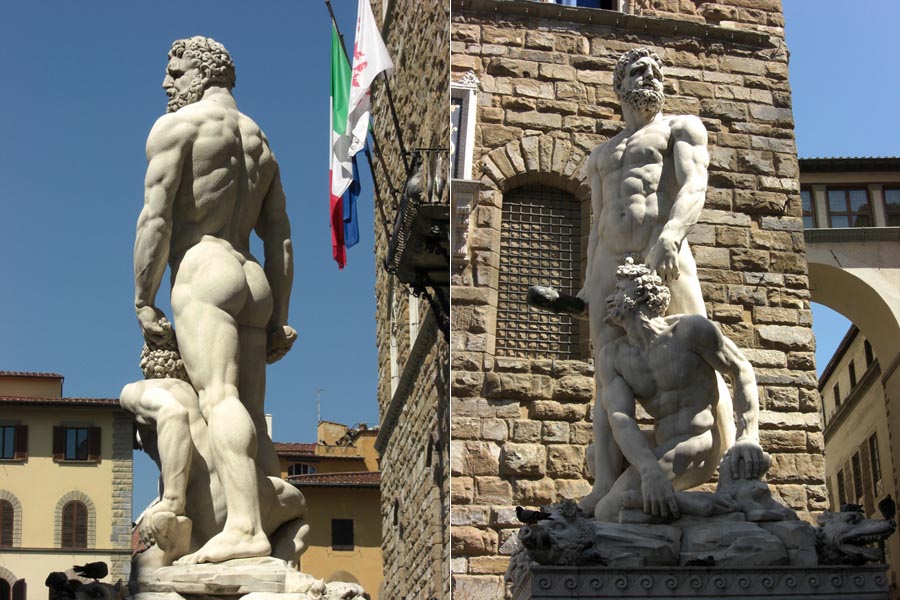
Hercules and Cacus, a marble sculpture by Baccio Bandinelli, in the Piazza della Signoria in front of Palazzo Vecchio
This sculpture was originally commissioned to Michelangelo in 1505, but due to more pressing commitments in Rome, he barely had time to make a model now preserved at the Museum of the Casa Buonarroti. The commission remained only on paper, and was finally entrusted to Bandinelli, which he did in 1534. The allegorical theme is the strength and ingenuity of Hercules defeating the evil of Cacus, an episode recounted by Virgil and other poets in the saga of the twelve labors of Hercules.
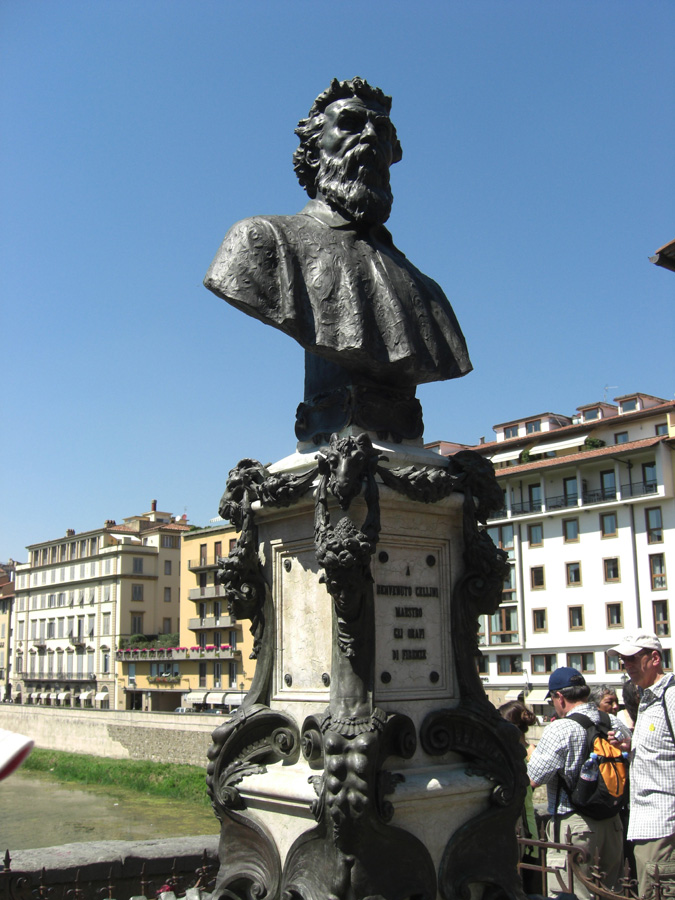
This bust of Duke Cosimo I de' Medici is by Benventuo Cellini,
who is a most colorful character with an interesting history
The story behind the bust’s creation is pretty wild, mainly because the artist who created it was something of a rogue. “The Autobiography of Benventuo Cellini” is one of the most hilarious books you can read from the period. Cellini rescues maidens from thieves, he pals around with the greatest artists of the time (Titian and Michelangelo), he kills six different men (one was his wife’s lover…the others are dudes who looked at him funny), and is eventually imprisoned in the Castel Sant’Angelo. There he has mystic visions and is saved by an angel, falls 50 feet from the walls of the prison after trying to escape, breaks his leg, and wanders through the streets of Rome. Oh, did I mention that he single-handedly killed the Prince of Orange with a well placed musket ball between the eyes during the Sack of Rome in 1527, and helped defend Pope Clement VII by manning the canons on the Castello? Imagine something out of Rambo-like in violence where among a mass of scattered dead bodies, a lone artist is protecting the pope from an entire army…his shirt torn open just right…hair blowing in the wind…and somehow during all of this, he had time to create artwork. Well…you know…they didn’t have TV.
In 1545 Cellini returned to his home town of Florence. Having lived in France for the past few years working for Francis I, Cellini had a high opinion of himself. He had worked for the King crafting some of the finest metalwork in Europe (some candlesticks and a saltcellar, and the famed “Nymph of Fontainebleau”), so naturally he needed a job that was on a similar income level. Who could he turn to but the Duke of Florence? Now, the difference between Paris and Florence in the sixteenth century was considerable. It would have been like moving from New York/Los Angeles (take your pick) to Boston. One had all the glitz and glamor of the big city and for an artist must have been a sight to see. Florence instead was famous, but you had no idea why, really (like Boston). It was sizable but in the middle of nowhere. People talked with funny accents and all they could yammer on about was that Michelangelo should come back from Rome and save the city from artistic desolation. Indeed, at one point Florence had a lot of artistic talent to its credit, but most reputable artists had left for the big cities. People in Europe were paying attention to the tiny Italian town, but always with a sense of confusion. It wasn’t very powerful or even very financially well off, but it had…something. Of course Duke Cosimo I was trying to change peoples’ opinion of the city, first and foremost with artistic commissions from men like Cellini.
The bust was the first work that Cosimo commissioned from Benvenuto upon his arrival to his hometown. Cellini was a native son, but he had been away for quite some time, so Cosimo needed to make sure all that French air hadn’t rotted his homegrown Florentine artistic ability. The work was intended as a trial piece, to challenge Cellini to see if he could cast something in bronze that was monumental in size, a process that had more or less been lost since classical antiquity. Cellini managed to pull the work off, creating one of the largest metal busts cast since ancient Rome (seems a little cooler now, right?). The bust of Cosimo glares out at the viewer with a rather intense look of determination, dressed in an ancient Roman cuirass (fancy word for armor), shown as the defender of Tuscany. In 1557 the bust was shipped to the island of Elba, and placed inside a fortress that Cosimo had built to defend the coastline from Turkish pirates. But in order to remember the work, Cosimo commissioned Cellini to make a copy in marble which is now in the De Young Museum in San Francisco. By that time Cellini had so thoroughly irritated the Duke with his insanity (he managed to get into more trouble at home, fleeing from a night watchman and hiding out in Venice for a time) that he was left an old man in Florence, with little to do but write his own memoir. The bust would remain on Elba (Napoleon did a little redecorating with it when he was there…) until the 19th century when it was brought back into Florence and placed in the Bargello for safekeeping. If you get a second while you’re in Florence, go make friends with it. Stare into Cosimo’s eyes and think of what your life would be like if you didn’t watch so much TV.
I know that there is a technique known as "lost wax" for casting bronze statues, and I could easily learn it, but I'd still have to have the skill of the artist to create such beautiful masterpieces as seen below. So my admiration for those who have that skill is boundless. Benvenuto Cellini may have been a little crazy, but he was a brilliant and accomplished artist, no question, as Perseus below testifies.
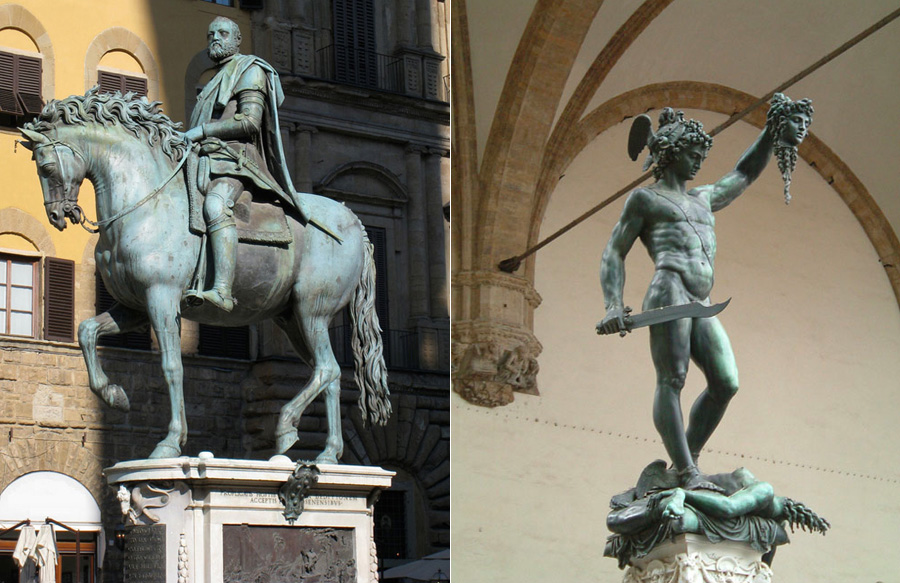
Cosimo I de' Medici, Grand Duke of Tuscany Perseus With the Head of Medusa
by Giambologna by Benventuo Callini
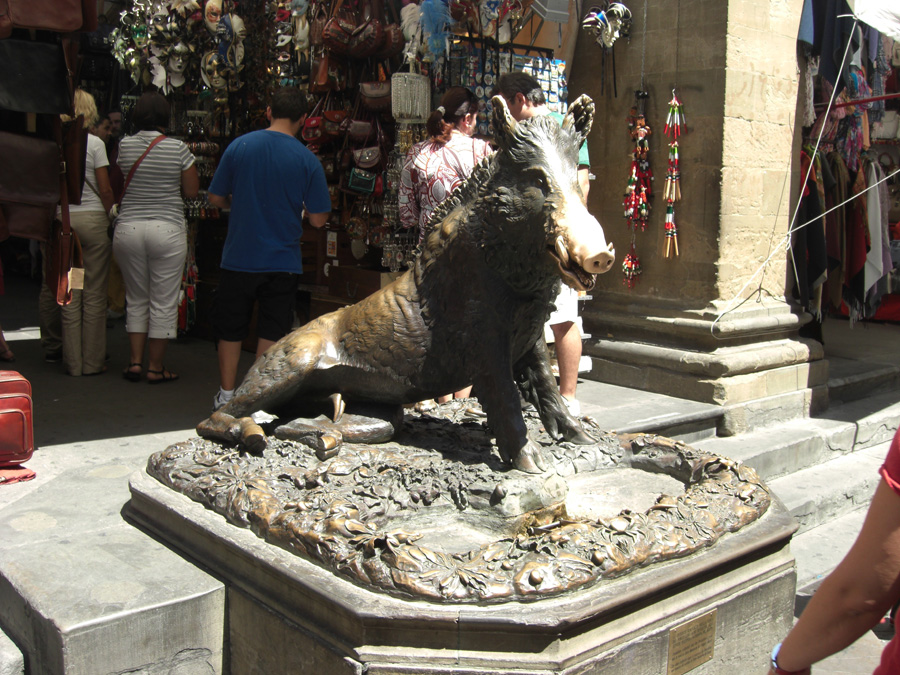
The Florentine Boar is world famous, and is a copy of the original boar that was carved from marble during the
centuries BC by a Greek sculptor, and was either lost or destroyed. It has been suggested the original ancient
Greek marble Boar was thought to be a part of a larger group representing a hunting scene, where he was just
awakening having been disturbed by the hunt.
It reminded me of the Bronze Bull on Wall Street in Manhattan. His nose is polished bright and worn smooth from the thousands of tourists who believe it to be good luck to rub his snout. A bronze casting was made by Pietro Tacca in 1612 who changed the base of the simple Greek statue by adding a pool surrounded by plants, snakes, frogs and turtles. It sits in the Marketo Nuovo (New Market) in Florence. The Florentine Boar remains one of Europe's significant art works, copies of which can be found around the world.
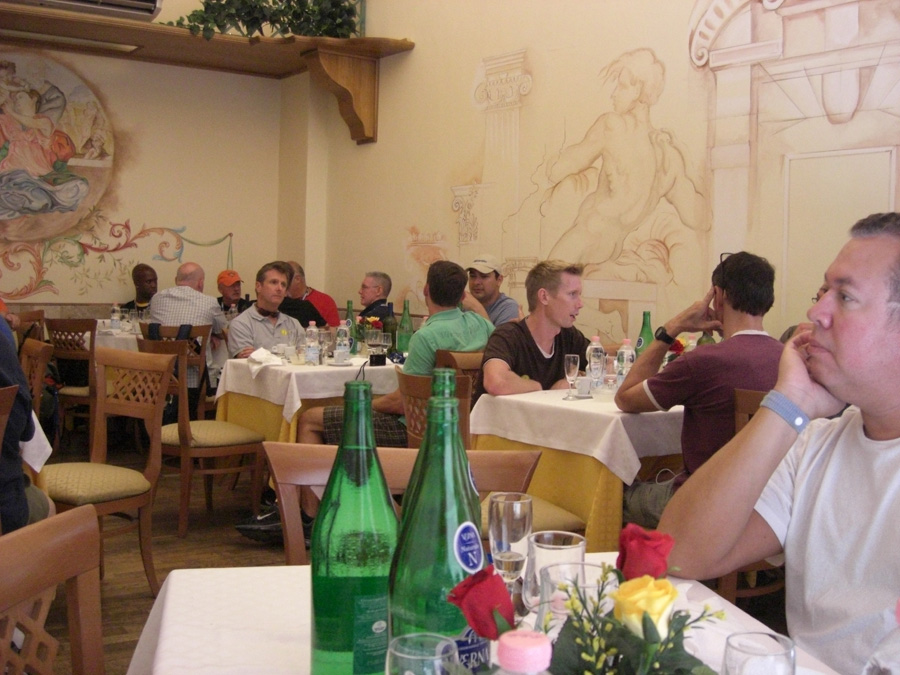
I took this shot of the walls inside the restaurant where our group enjoyed a delicious meal before leaving Florence.
Note the sketches on the walls partially finished. Florence is very definitely a city of art.
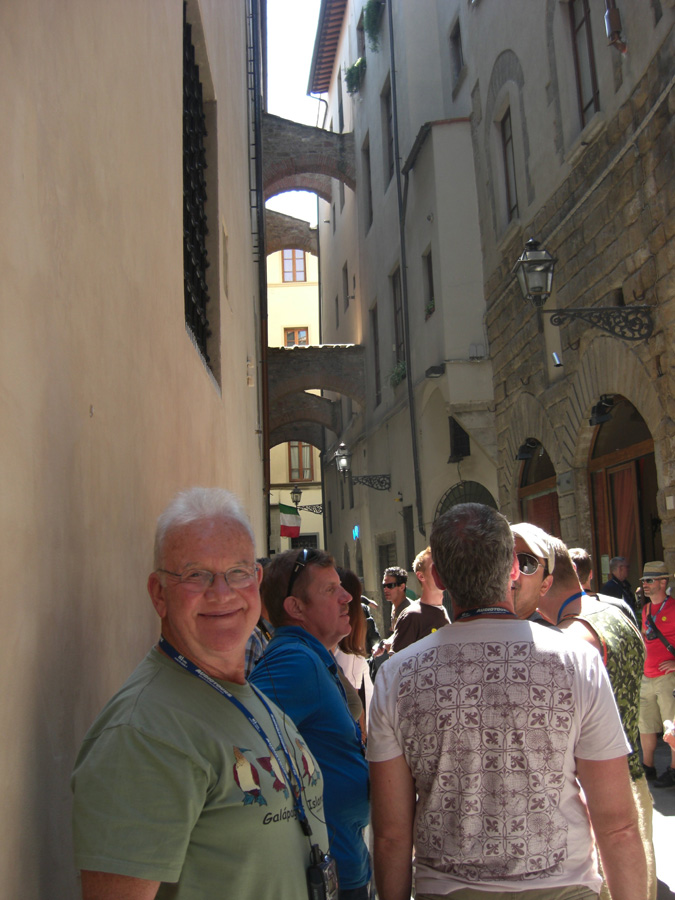
We are outside the restaurant after lunch, waiting for the group to reform for a
walk back to the motor coach. I thought the architecture was interesting here.
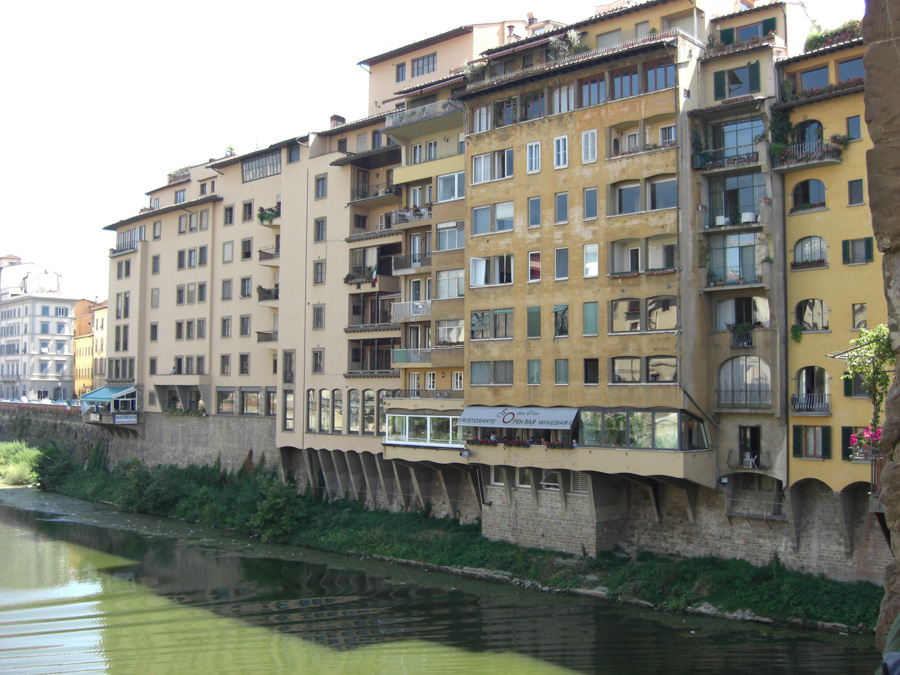
I thought it was interesting how the back sides of many of these buildings, the ground floor obviously
being a restaurant, had built out over the edge of the river to provide an interesting dining experience.
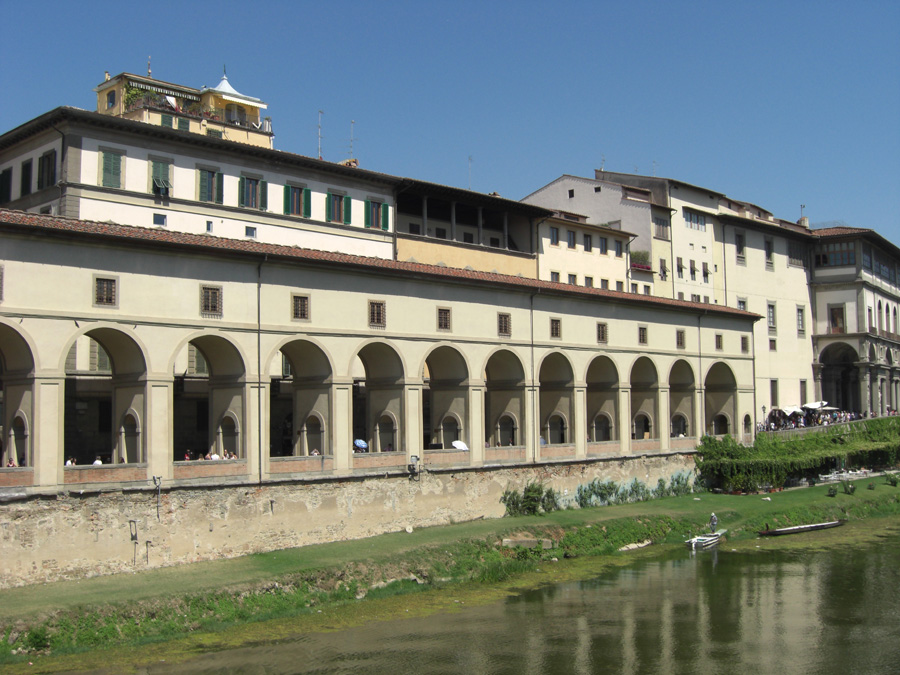
It appears that during the rainy season, the level of the river can rise several feet. I wondered what it might be like at flood stage
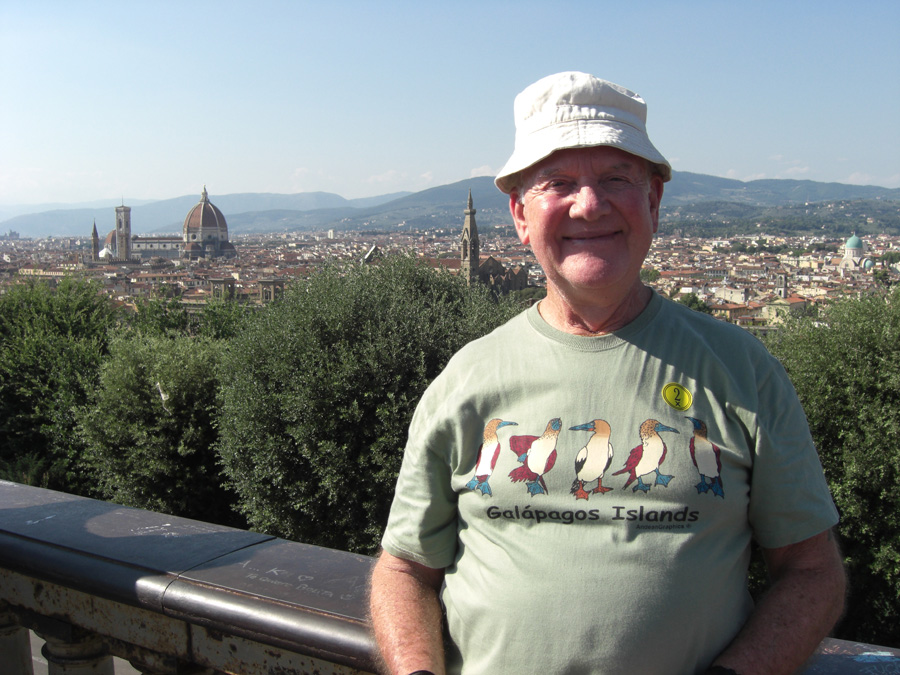
From Michelangelo Square you see Florence spread out behind me, and we wish we had more time to explore
more of this fascinating Italian city, and that's reason enough to return some day.
Florence originated as a Roman city, being established by Lucius Cornelius Sulla in 80 BC, and later after a period as a flourishing trading and banking medieval commune, it was the birthplace of the Italian Renaissance. According to the Encyclopedia Britannica, it was politically, economically, and culturally one of the most important cities in Europe and the world from the 14th century to the 16th century. The language spoken in Florence during this period became, above all the local dialects, the language of choice for all of Italy.
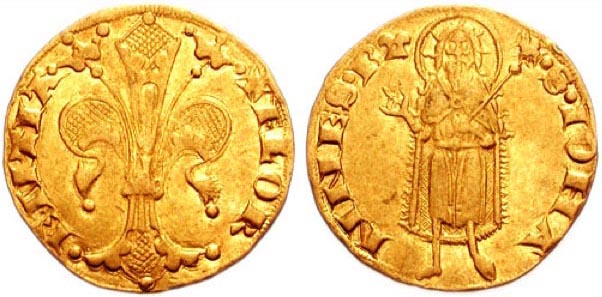
Starting from the late Middle Ages, Florentine money―in the form of the gold florin―financed the development of industry all over Europe, from Britain to Bruges, to Lyon and Hungary. Florentine bankers financed the English kings during the Hundred Years War, as well as the papacy, including construction of their provisional capital of Avignon and, after their return to Rome, the reconstruction and Renaissance embellishment of the latter.
Florence was home to the Medici, one of history's most important noble families. Lorenzo de' Medici was considered a political and cultural mastermind of Italy in the late 15th century. Two members of he family, were popes as Leo X and Clement VII in the early 16th century. Catherine de Medici, married king Henry II of France and, after his death in 1559, reigned as regent in France. The Medici reigned Grand Dukes of Tuscany starting with Cosimo I de' Medici in 1569, until the death of Gian Gastone de' Medici in 1737.
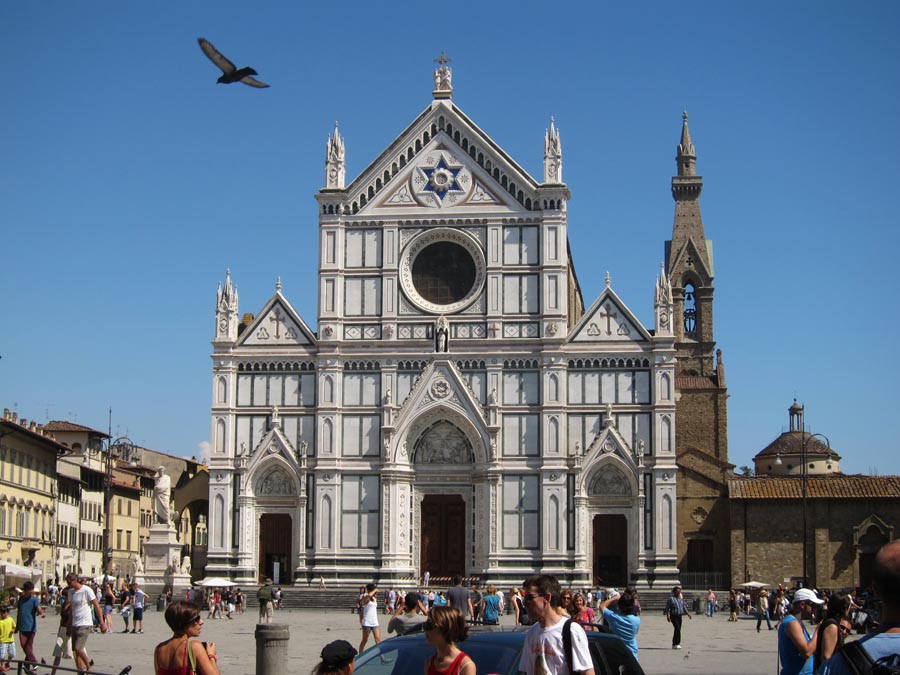
This is the Basilica of Santa Croce, the principal Franciscan church in the city. It is situated in the Piazza di
Santa Croce, about 800 meters south east of the Duomo, and is the burial place of some of the most illustrious
Italians, such as Michelangelo, Galileo, Machiavelli, Foscolo, Gentile, Rossini and Maroni. It is known as
the Temple of the Italian Glories.
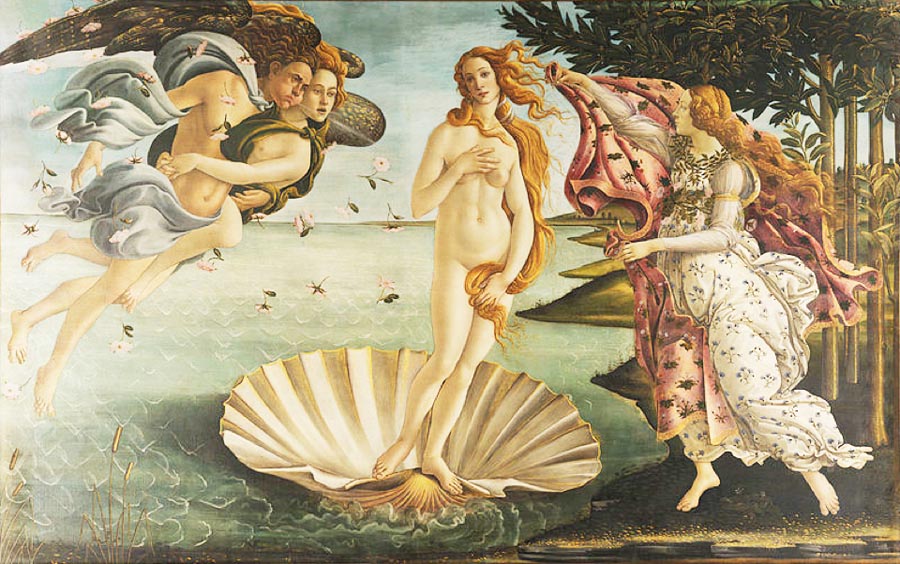
The Birth of Venus by Sandro Botticelli is a big attraction in the Uffizi Gallery
But alas, I must move back on board the ship and get us moving towards the French Riviera.
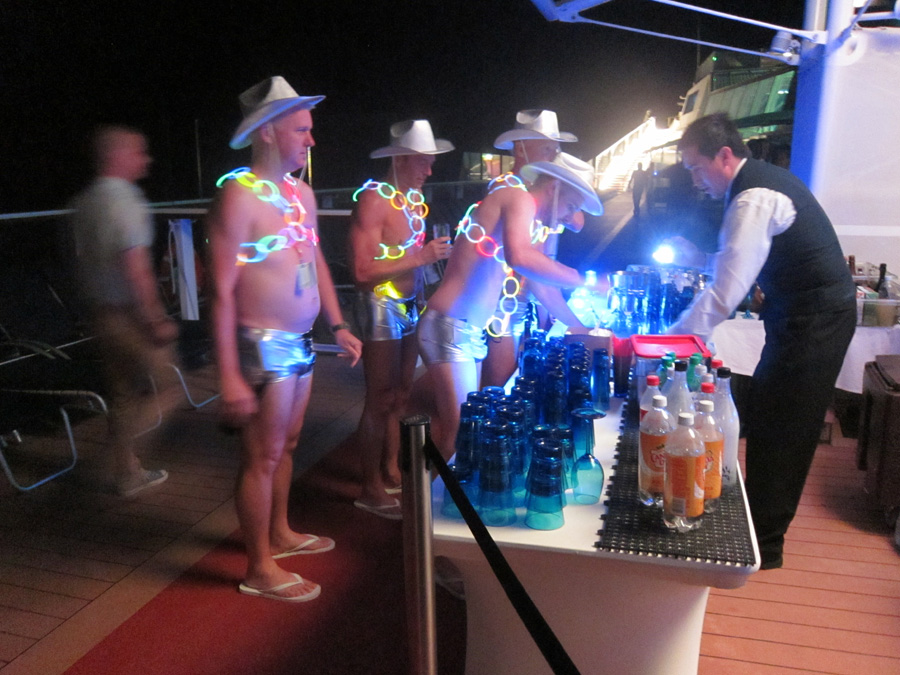
Back on board the ship, it is now nighttime, and the night is warm, fortunately for these cowboys. You
may think, as I did, that these guys look pretty silly, but when they get on the dance floor, with the light
show and the disco music, the action in incredible. Everything else seemed to pale in comparison.
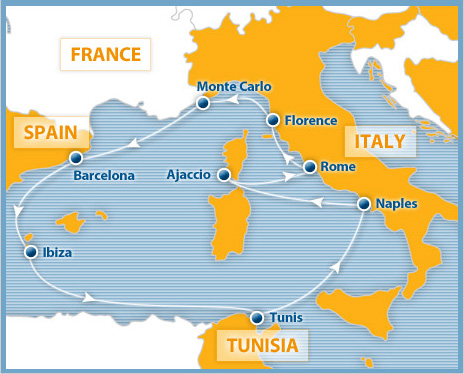
Through the night we will be cruising from La Spezia
(Florence) to Monte Carlo on the French Riviera.
I suppose you've all read about the cruise ship Costa Concordia running aground off the coast of Tuscany. It left the same port that our ship did on 1 August 2011. I'm glad that we were fortunate enough to miss the island of Giglio as we left port.
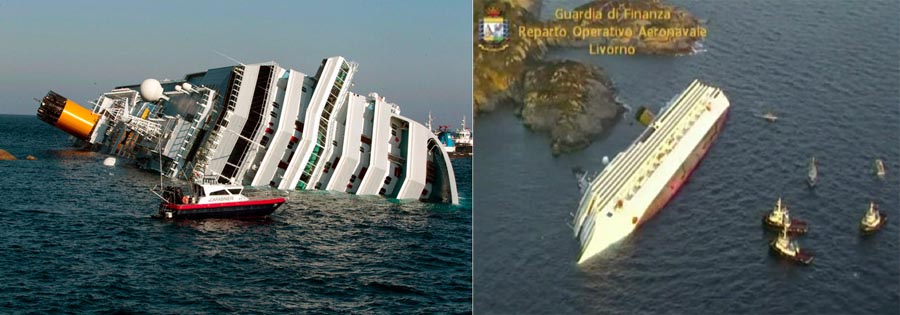
This is definitely NOT the way you want your vacation to begin. I'm sure this will deter a lot of
potential clients of the cruise industry from booking future cruises for a long time to come..
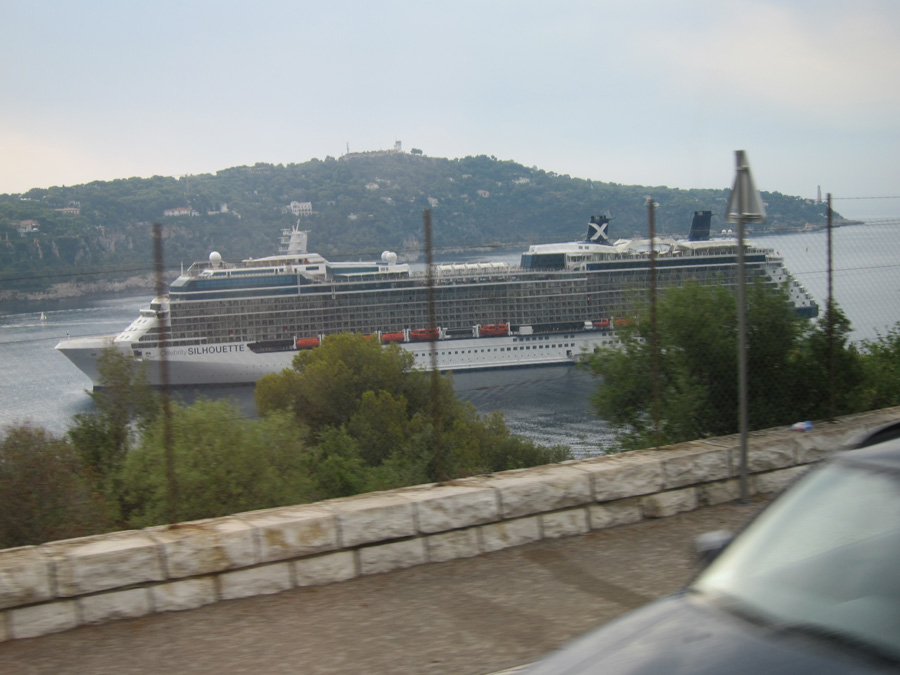
Our ship is safely at anchor in the Port of Fontieville, and we are on a motor coach heading for Monte Carlo
But for now it is time to end this chapter, and the next chapter will find us in Monaco, to visit the Royal Palace, and see the fascinating city of Monte Carlo, home of the famous La Grand Casino.
|