 |
|
|
|
|
|
|
|
|
|
|
||||||||
|
||||||||||||||||||
|
Email us at: |
||||||||||||||||||
 |
||||||||||||||||||
 |
 |
|||||||||||||||||
|
Click the sun to see the |
||||||||||||||||||



|
 |
|
|



|
|
||
|
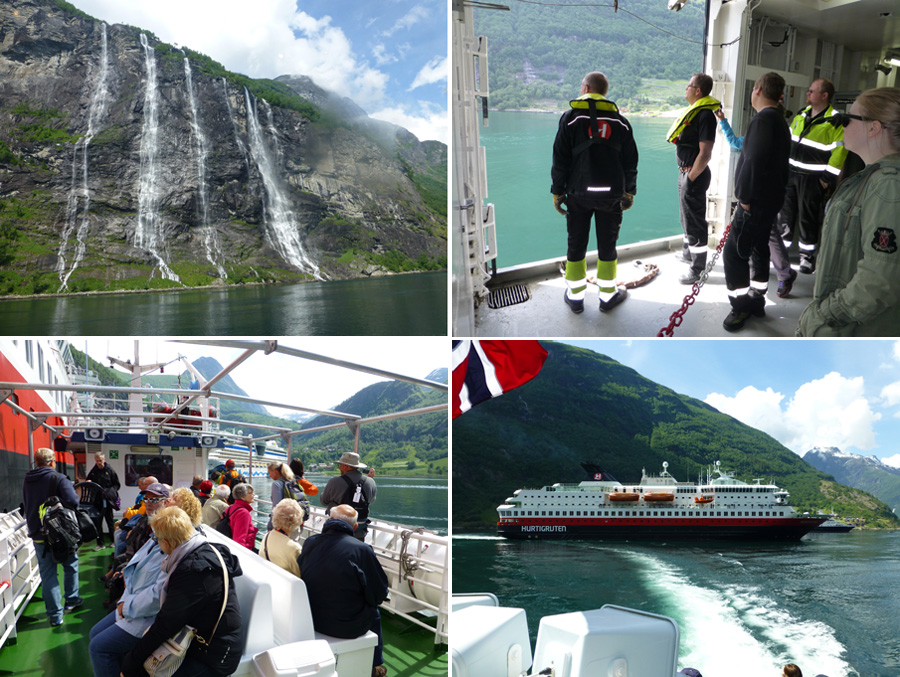
Our first shore excursion occurred on Day 2, when we entered the Geiranger fjord, a UNESCO-listed site. We saw magnificent water falls streaming down the mountain sides. We would be taken ashore by a tender, for which the crew awaited.
They made boarding the tender a breeze. It was a beautiful day for the excursion. As we sped away from our ship, it was again under weigh, heading for it’s next port of call, Ålesund. Some statistics on our ship, the M/S Nordnorge, meaning Northern Norway. It was constructed in Kvaerner Kleven, Norway; it can carry 623 passengers, and has beds for 451 passengers; car capacity is 45; gross tonnage is 11,384 tons; length 123.3 meters; beam 19.5 meters; speed 15 knots. The interior décor very much reflects an Art Nouveau and Art Deco influence. Passengers who board with their vehicles are normally going from one port to the next, thus do not require a bed. People have traveled along the Norwegian coastline with “Hurtigruten” since 1893. The journey is known as “The World’s Most Beautiful Sea Voyage”.
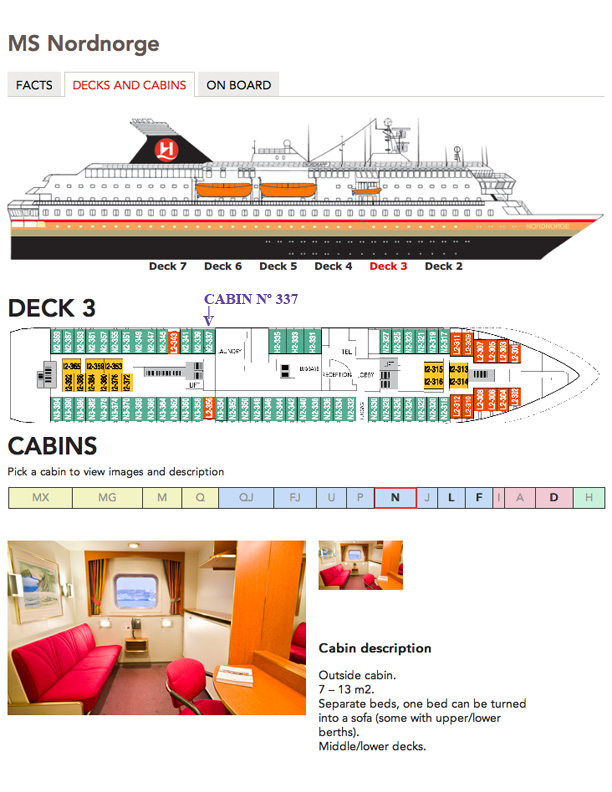
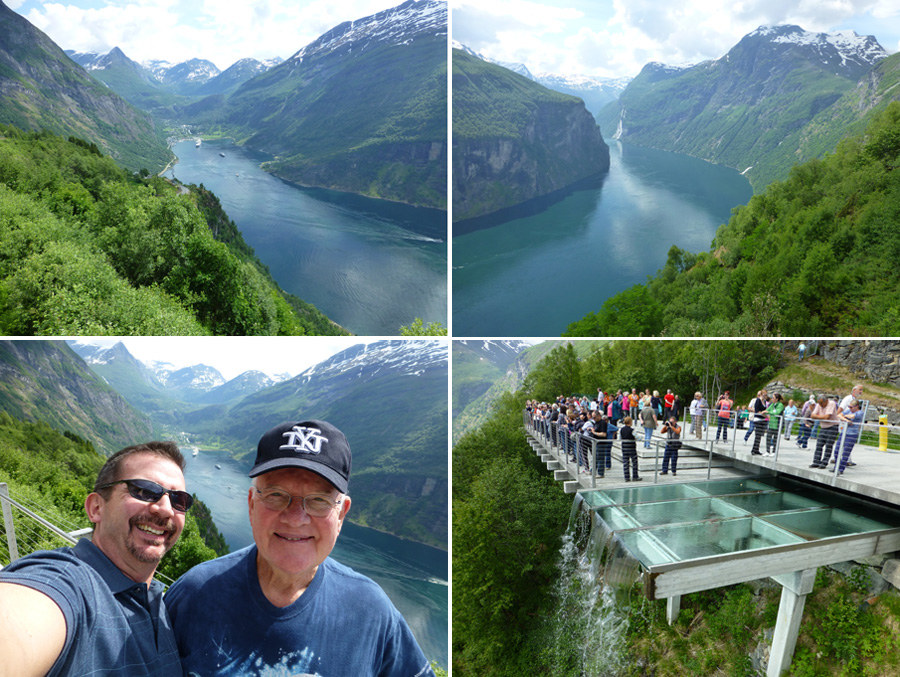
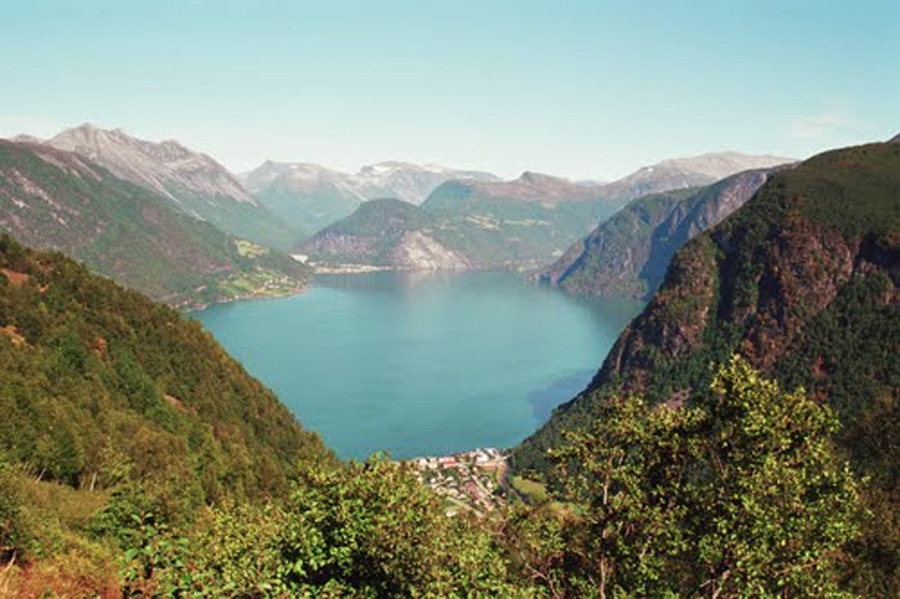
Our cabin was on deck 3, which was very convenient as the lobby was just down the hall forward from us, and that was were most of the debarkation and embarkation took place. The photo of the cabin above could have easily been taken in our cabin, as it looks identical. We left the ship at half past one in the afternoon, and did not rejoin it until 9:30 PM that evening. The interim was spent going by motor coach and ferry from Geiranger fjord to Molde, seeing some very beautiful sites along the way. From a magnificent vista point we looked back down at Geiranger fjord.
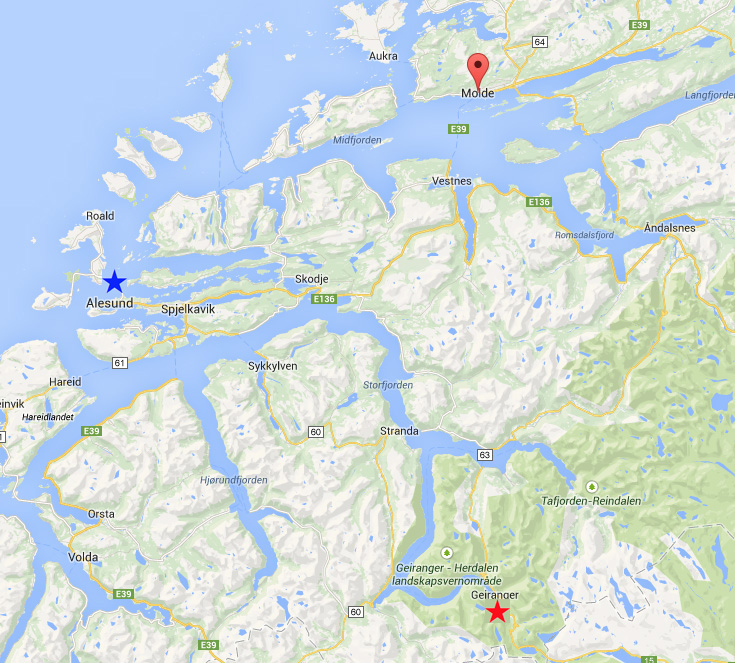
As the crow flies, Geiranger (★?) is a little more than 68 kilometers from Molde. Our ship stopped at Ålesund (★?) at 9:00 AM, dropped us off at Geiranger fjord at 1:30 PM, then made a second stop at Ålesund at 6:00 PM, and made its way to Molde to pick us up at 9:30 PM.
From Geiranger fjord our motor coach took us up into the mountains, and through some of the most beautiful country you can imagine. At the top we stopped at the beautiful Eidsdalsvatnet Lake.
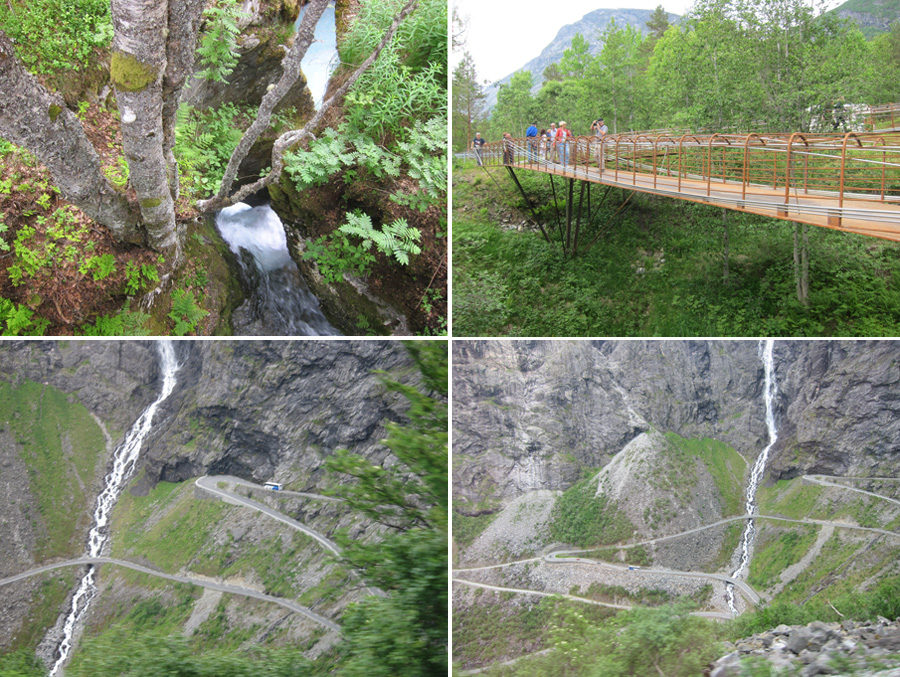
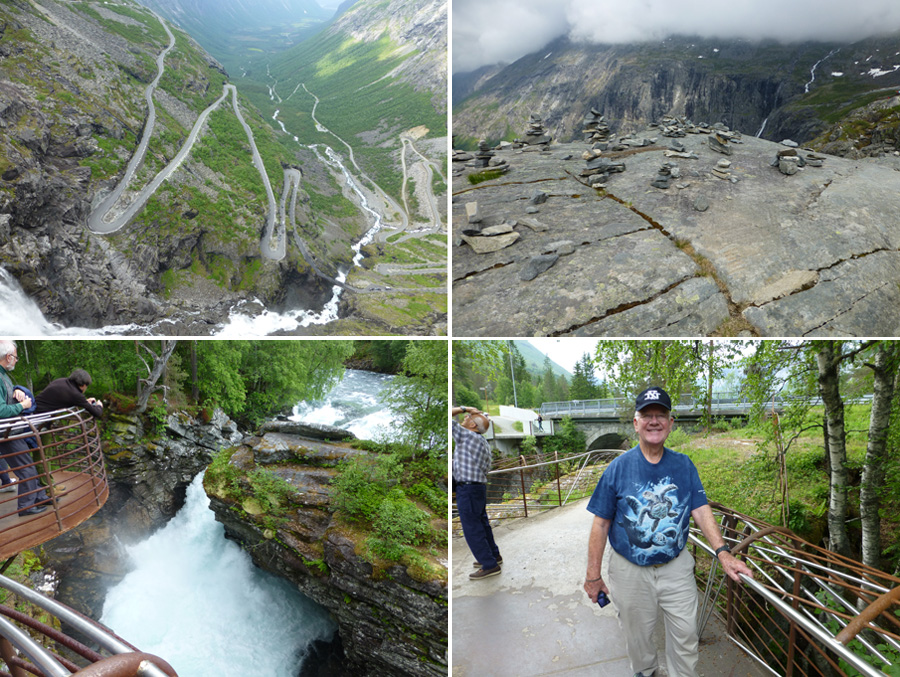
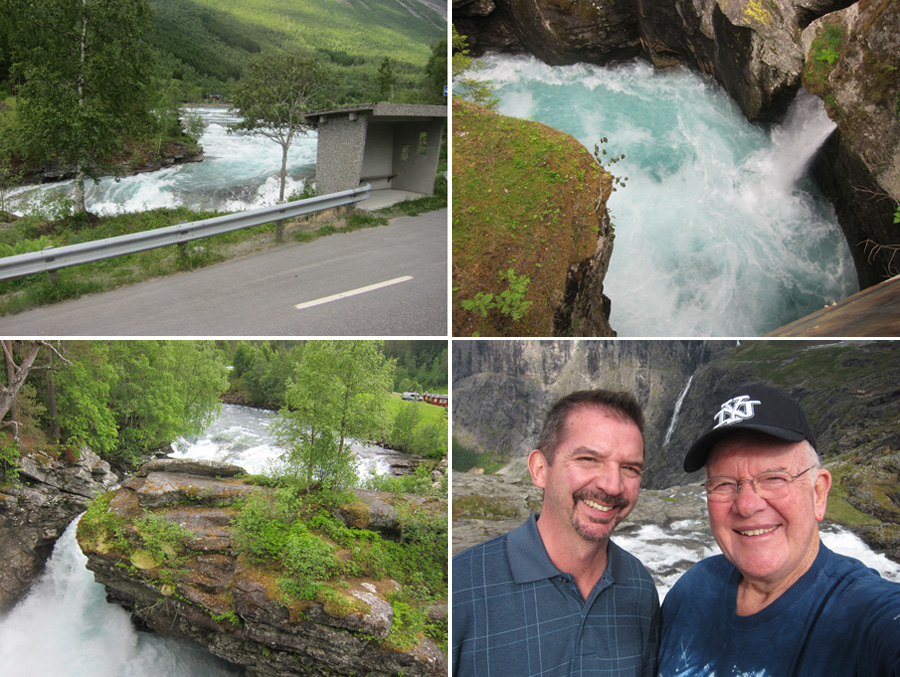
Where the water left the lake it was via a spectacular water fall, dropping several hundred meters into Trollstigen Pass, with it’s 11 hairpin bends to the bottom of the pass.
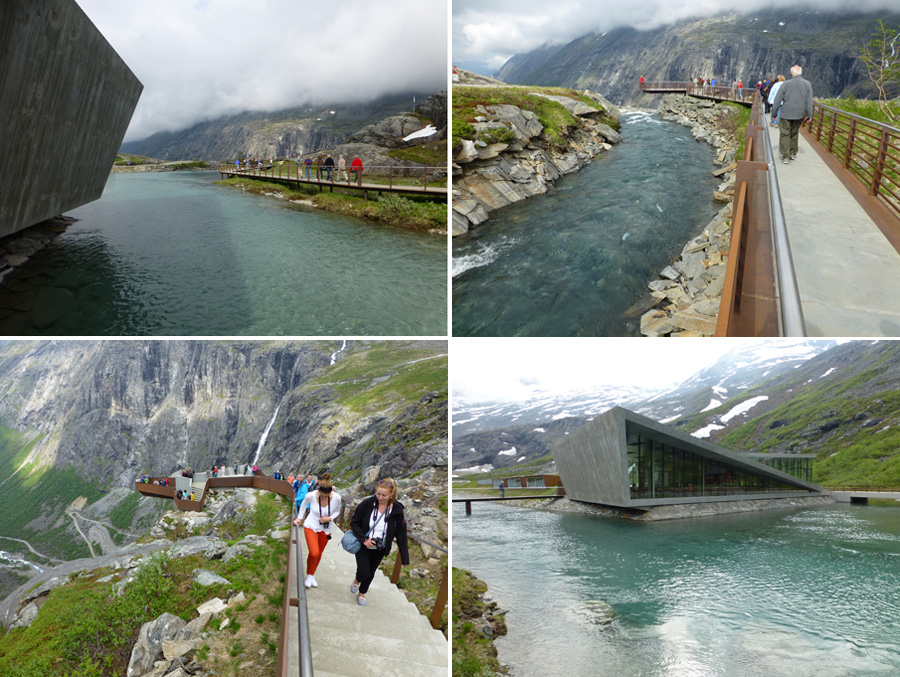
This overlook is like the Skywalk overlooking the Grand Canyon, but without the glass floor. You are still hanging out in space.
It seemed like the motor coaches were too large for the sharp hairpin turns. I was on the edge of my seat most of the way down. The hairpin bends in the road were a definite challenge to anyone driving this route for the first time. Fortunately, our driver has made the trip many times, and the only thing I had to think about was the hope that the brakes and the tires were in tip top condition. I was grateful that Norway could not be considered a third world country, otherwise such a trip down the mountain would be considered at best a perilous adventure.
The rocks piled up were put there by hikers, although I don’t know why. The gorge at the top was breathtaking, with a suspended walkway over the beginning of the drop. The roar of the water as it succumbed to the pull of gravity gave one a keen sense of the powerful forces that are inherently a part of Nature.
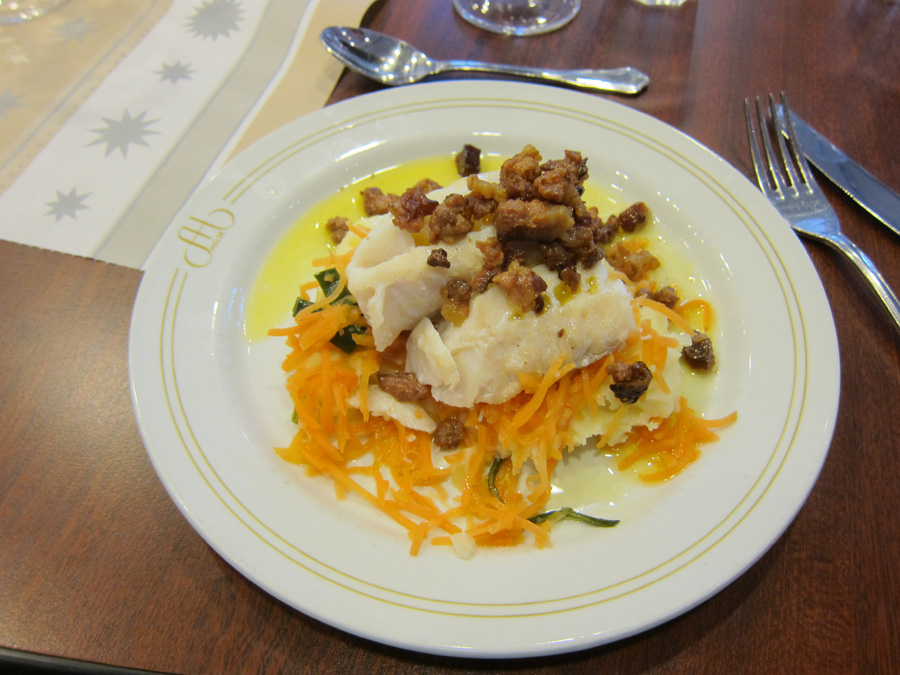
When we reached Molde, after crossing a few bodies of water on ferry boats, we had dinner at a hotel restaurant. Molde is internationally known for its annual jazz festival, and it boasts a population of 25,000 inhabitants. We were dropped at a major hotel in town, and directed to the dining room. The meal was stockfish, and it was quite good. You’ll learn more about stockfish in a later chapter.
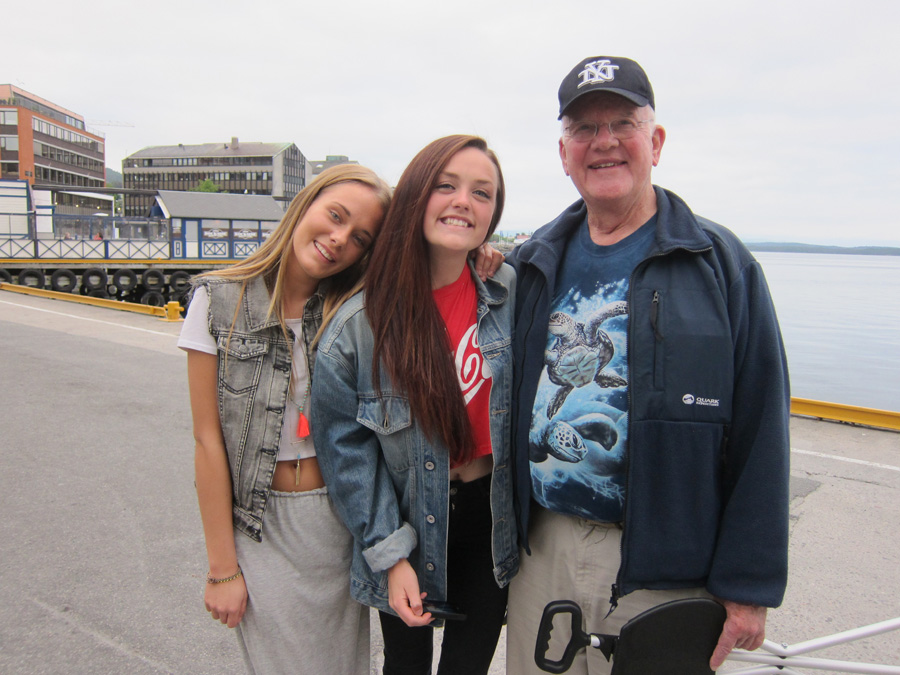
After dinner, we had some time to kill before the ship arrived. Pete and I walked around town, as did everyone else in our group. As we approached the wharf, two young girls got out of an expensive looking car, and approached us. We were uncertain as to their motive, and they started asking us questions about where we were from, why we were here, etc., etc. They were very upbeat about their town, and were praising its many amenities. It was quite strange to us, as if they were employed by the local Chamber of Commerce, or something like that. There was a young boy sitting in the driver’s seat watching us, and smiling. Finally, Pete asked if they were acting on a dare. They laughed, and said no, they were just interested in foreign visitors, and our opinions about their town, and about Norway in general. Once we were convinced that they were harmless, we had a pleasant chat with them, and learning a little more about the Norwegian culture through the eyes of its youth.
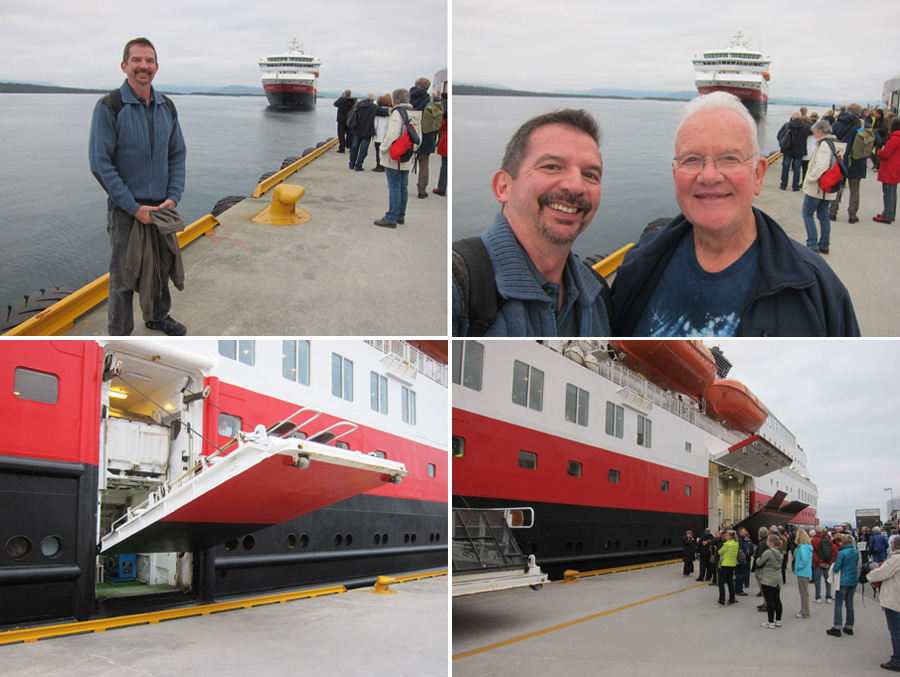
Don’t they seem awfully young to be approaching total strangers like us? We saw our ship coming in the distance, so we bid our new young friends goodbye, and wished them luck in their further adventures with tourists.
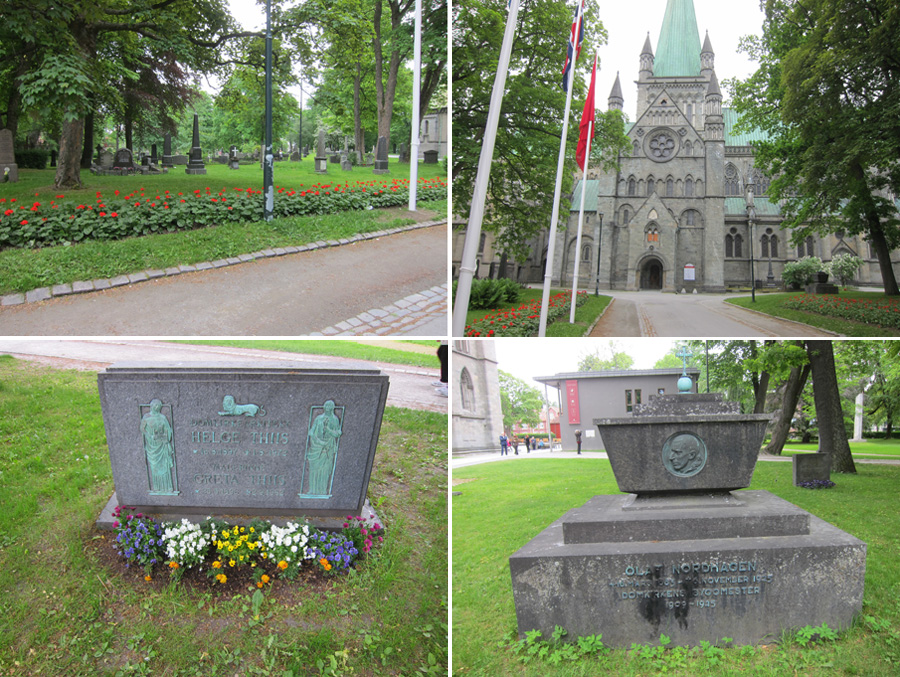
The ships crew were very efficient at mooring the ship quickly and getting the loading ramps down, one for passengers, and the larger one for vehicles and the loading and offloading of supplies, evidence that these Hurtigruten ships truly are working ships. On Day 3 our shore excursion was to take place in Trondheim, Norway’s third largest city. An ancient city, it was founded by the Viking King Olav Tryggvason as early as 997. The tour took us to Norway’s national shrine, Nidaros Cathedral - Norway’s only Gothic style cathedral, build over the burial place of St. Olav, Norway’s patron saint.
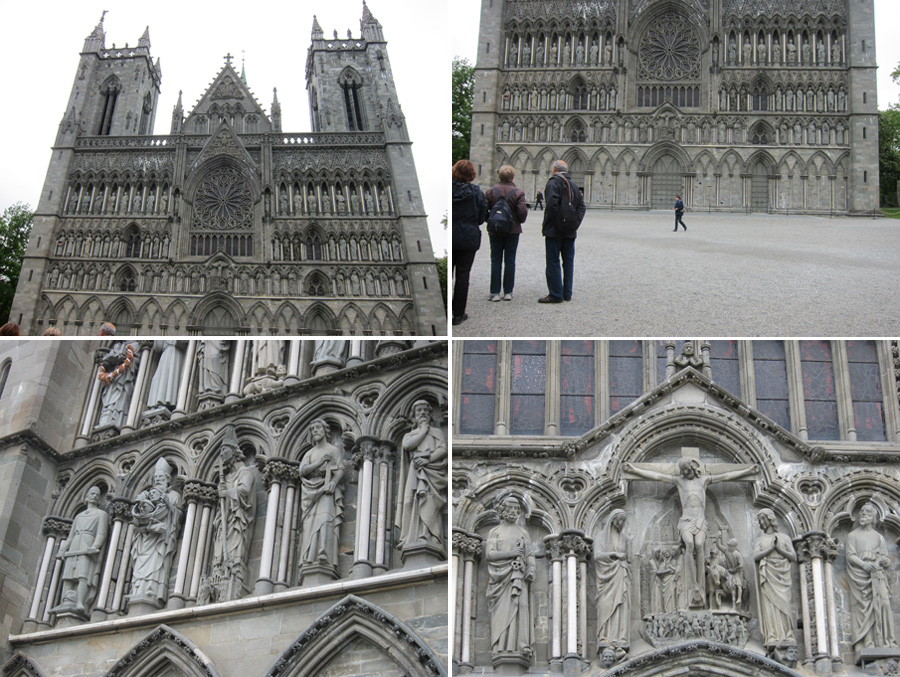
Nidaros Cathedral is the traditional location for the consecration of the King of Norway. It was built from 1070 to 1300, and designated as the cathedral for the Diocese of Nidaros in 1152. After the Protestant Reformation, it was taken over by the Lutheran Church in 1537. It is the northernmost medieval cathedral in the world.
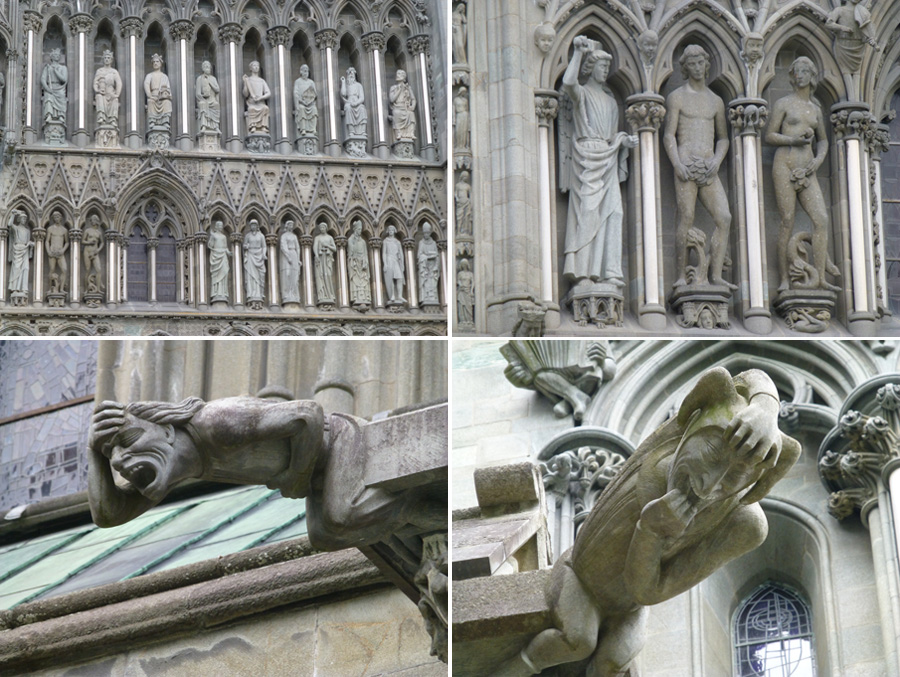
Standing in front of the cathedral while our guide gave us his running commentary on its history, one could not help but feel a little awestruck by this imposing structure, which seemed so out of place from everything else we had observed so far. The statuary of the various saints was nothing short of magnificent, each one unique an interesting in its own way. I had the sense that I was actually standing in Saint Peter’s Square in the Vatican.
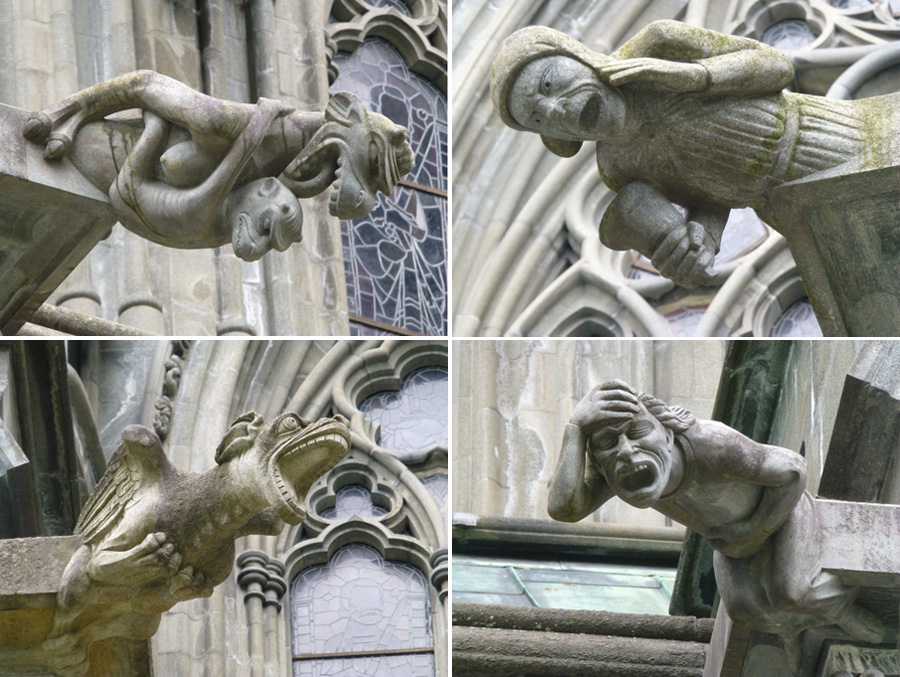
The gargoyles were certainly eye-catching in their expression of horror and fear. Although I can appreciate the art of them, I’ve never been able to figure out the reason behind them. Do they ward off demons or evil spirits? Or do they just scare little children so that they will be quiet inside the church. According to Google it is the former. Honestly, how did we ever survive without Google?
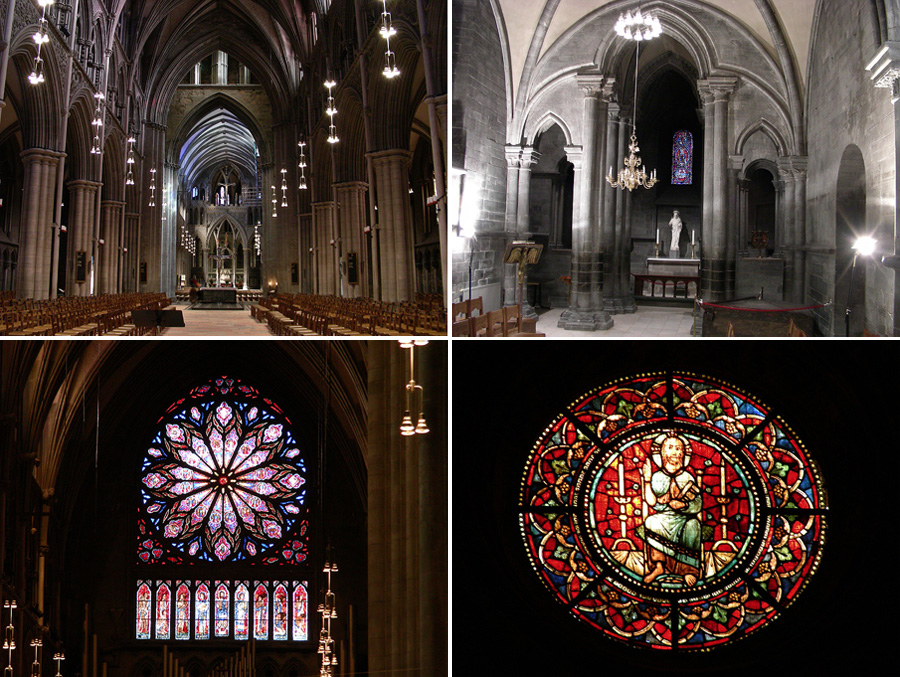
We were not allowed to take photographs inside the church, so the following are complements of the Internet.
The inside of the church was pretty impressive, and the young lady we had as our guide gave us a very interesting talk about the church history, and especially about King Olav who is reputed to be buried beneath the main alter. She told of how the body of Olav was not decayed after being buried for more than a year. She condensed the story that follows into a period of perhaps 5 or 10 minutes, holding us all spellbound. If you can spare the time to read below, you might find the story of Olav the Holy as interesting as I did. I do not claim that any of what follows is true. I leave it up to you to decide for yourself what to believe. From the link below I have selected only the last third of this article, and pasted it below. http://www.internationalschoolhistory.net/medieval_pilgrimage/legends/stolav.htm With an army of 240 men, Olav started, in 1030, to sail back along the frozen Russian rivers, until he reached the coast and eventually got to Sweden. There he met his old friend Anund Jakob, who gave him approximately 500 well-equipped soldiers. On his way to Norway, which went through Bergslagen towards Tröndelag, several relatives and nobles went along, joining forces with Olav, so that, by the time he finally reached Norway, his army had grown to 3000-4000 men. His enemies, on the other hand, hadn’t been biding idle time. Olav Haraldsson met an army of farmers from Tröndelag, three to four times the size of his own army, and led by his main opponent. The battle came to be at the farm of Stiklestad, nine hundred kilometres north of Trondheim, on the 29th of July 1030, and ended in a catastrophic defeat for Olav and his men. Olav himself was killed. Olav’s defeat was so absolute, that his campaign seemed hopelessly lost. But, now strange things started happening. The man, Tore Hund, who had forced his spear through King Olav, sought out the body of the king on the battlefield, noticing that the king’s face was as healthy and full of colour as when he was still alive. Also – one drop of the king’s blood miraculously healed a wound on Tore Hund. A farmer, Torgils Hålmasson, and his son Grim, later retrieved the corpse, wrapped it in linen cloths, and laid it in an outhouse. A blind man came to them, asking for shelter in their outhouse, and when he came in contact with the dead body, he regained his sight. Torgils and Grim also seemed to see a strange light from the outhouse, to the point where they worried that the enemies of the deceased would find the body and desecrate it. So they made two coffins – one for the king, and one full of rocks and dirt. After a few minor complications, Olav’s enemies in the Fiord of Trondheim sank the coffin with King Olav wound up in a sandbank by a river, while the false one, with dirt and rocks sank to the bottom. This could have been the end of the story of the Norwegian King Olav Haraldsson. In a way it is – for now starts instead the story of Olav the Holy. Nothing turned out as the winners of the battle at Stiklestad had expected. King Knut of Denmark and England gave his son Sven the title King of Norway. Sven initiated new harsh laws after foreign model, new taxes and new duties. Also nobody was allowed to leave the country without the king’s personal consent. The Norwegians, who had hoped for a more autonomous rule, felt violated. The discontent was especially strong in Tröndelag. On top of all this, the crop failed and prices were high. More and more reached the conclusion that things had been better under Olav Haraldsson. People started seeing omens – even previous enemies of Olav, started viewing him as Holy. Torgils and Grim from Stiklestad, now dared to come forth and the bishop Grimkjell, Olav’s old friend and advisor, asked King Sven for permission to unearth the corpse. Strangely enough, the king agreed. One year and five days had passed since the king had been killed. It is told, that when the coffin was opened, it smelled fresh, and the body of the king was completely undecayed. His cheeks were rosy, as if he had only just fallen asleep, and his hair and nails had grown, just as if he had been alive. One sceptical spectator was Alfiva, the mother of King Sven: - Late rots the corpse that lies in sand, she claimed. It wouldn’t have been that way if they had buried the king in the earth! Bishop Grimkjell took a pair of scissors and trimmed Olav’s hair and beard, to show how much it had grown, but Alfiva refused to see it as a proof of holiness, unless the hairs were unharmed by fire. Grimkjell then laid the hairs on a fire, after having blessed it, and lo and behold – they remained unharmed. The holiness of King Olav had now been confirmed, and his body was carried into the Klemens-church, the church King Olav himself had founded, where he was buried following a highly ceremonial procedure above the high altar. Immediately omens started taking place, and in the sandbank where the body had been buried, a fresh spring suddenly appeared. Its water cured many sick people. The rumour of the holiness of Olav spread quickly, and people started flocking to Nidaros from near and far. Cripples, blind people and sick people would come here, and walk away cured from their ailments. The sound of bells could be heard over the grave, and the lights on the altar would light themselves. Remorseful Norwegians raised the flag of revolt once again, and only five years after the battle of Stiklestad, King Sven and his mother Alfiva were forced to flee to England, where both Sven and his father Knut died within a few years. The harsh Viking had become a saint – a surprising transformation, to say the least. It was also strange due to the fact that Olav didn’t die the martyr-death necessary for the title of saint. He died, weapon in hand, fighting an entirely worldly matter. Also – the fight at Stiklestad was no fight between Christians and heathens; among Olav’s opponents, as well as among his own troops, both religions existed, even if Olav is said to have tried to convert as many as possible before the battle. But only a few years after the death of the king, pilgrims had started visiting his grave. When Adam of Bremen wrote his great work about the history of the archdiocese of Hamburg-Bremen in the 1070’s, the pilgrimages to Nidaros were already widespread, attracting people from the North, as well as from the continent. Olav was never given any affirmation of sainthood by the pope, but at this time, it wasn’t required. The affirmation of the bishop was enough. It wasn’t until the latter part of the 12th century that the decision to make the affirmations of sainthood a matter for the pope only was taken. That is the story of the Viking chief Olav Haraldsson, who by means of violence and terror tried to christen his heathen countrymen, and who, after a terrible defeat in 1030, died while trying to reclaim the Norwegian throne. |
|
||||
|