 |
|
|
|
|
|
|
|
|
|
|
||||||||
|
||||||||||||||||||
|
Email us at: |
||||||||||||||||||
 |
||||||||||||||||||
 |
 |
|||||||||||||||||
|
Click the sun to see the |
||||||||||||||||||



|
 |
|
|



|
|
|
|
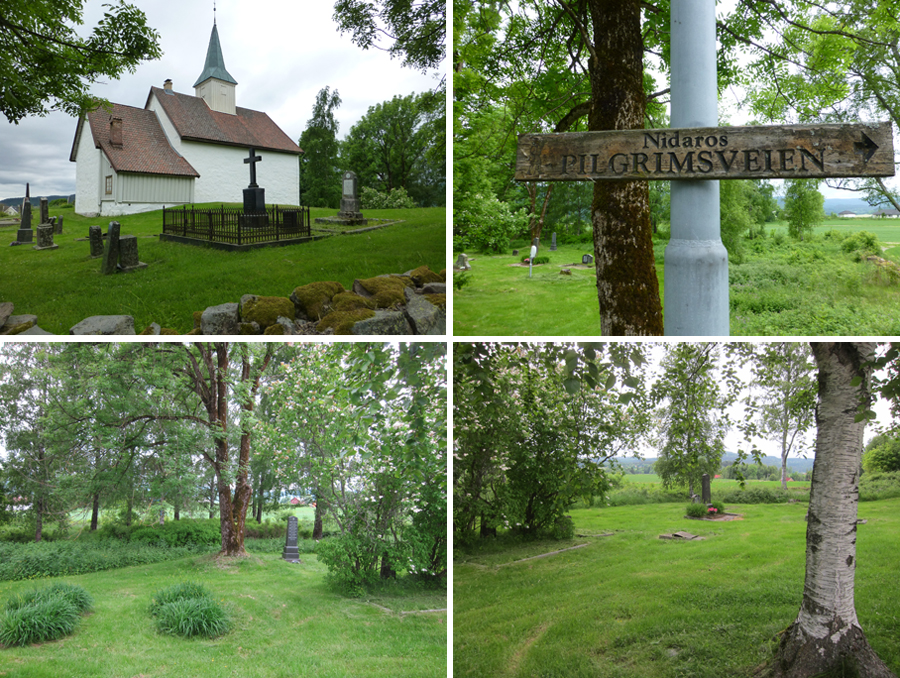
Aud drove her car through some of the most beautiful countryside as we headed for this old church. It is located on a hill overlooking farms and lots of open space. The grounds were peaceful and quiet, and seemed to be lost in time.
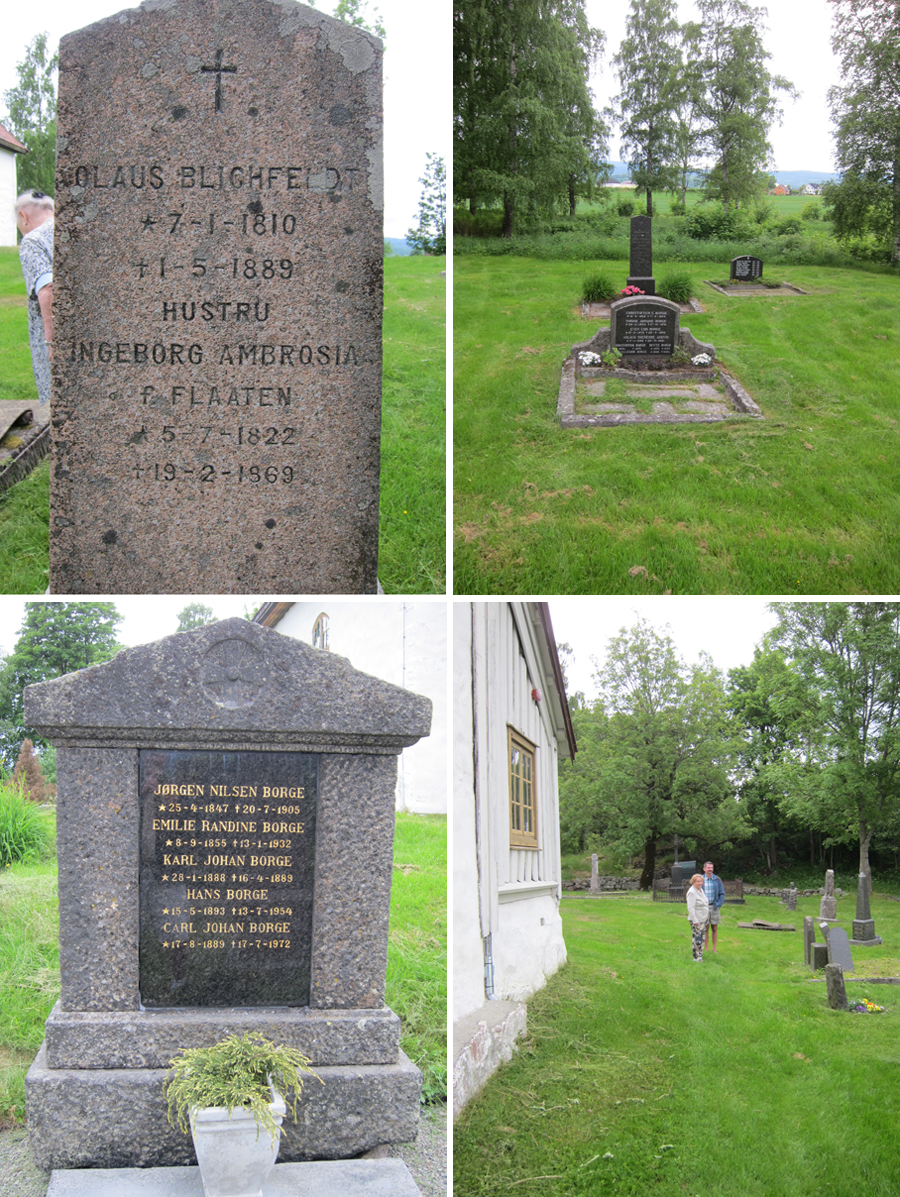
I always enjoy looking at the markings on ancient tomb stones. The most frequently seen name was that of the Borge family.
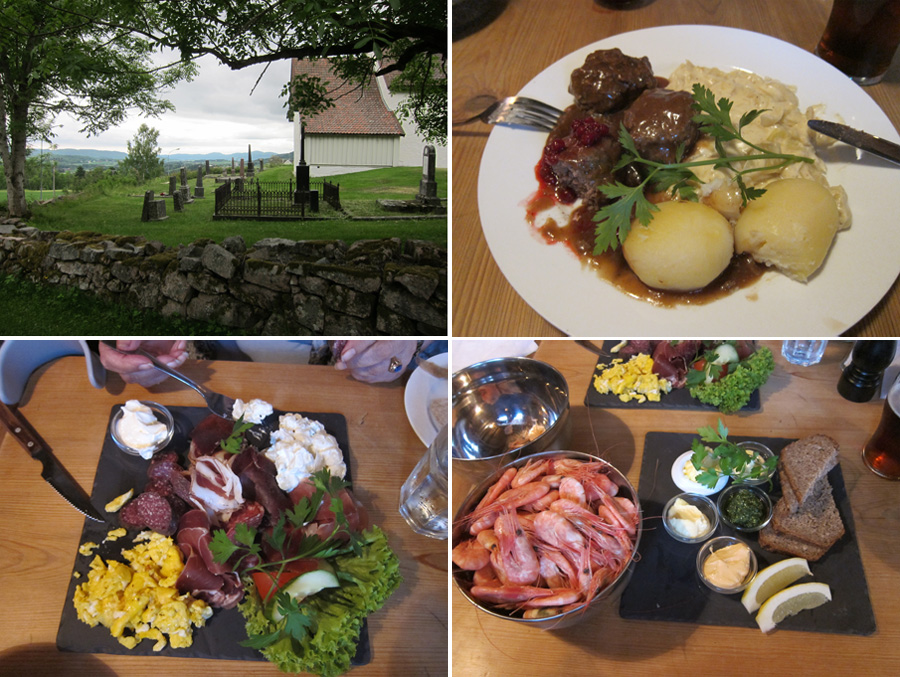
It was getting late in the day, and we decided to find a place for dinner. Aud knew of this old house, in fact the oldest house in Drammen, a log cabin which had been turned into a restaurant rather than tearing it down.
It was certainly a wonderful treat for us. Elis and I both ordered the Swedish meatballs, Aud ordered a plate of various meats and cheeses which included venison, and Pete ordered a tureen of shrimp that could have easily fed the four of us. Although I tried to help him out, there was way too much food, and my dinner was so good that I ate it all. Since it was an easy walk to our hotel, we decided to take our leave of Aud and Elis, thanking them for a wonderful day with them. It was just starting to rain, but only lightly, and Pete remembered a pub that he wanted to stop at to get the flavor of a Norwegian night out. His navigation was a little off, and we ended up going full circle around a few blocks before we came upon it. I believe it was called the Kings Arms.
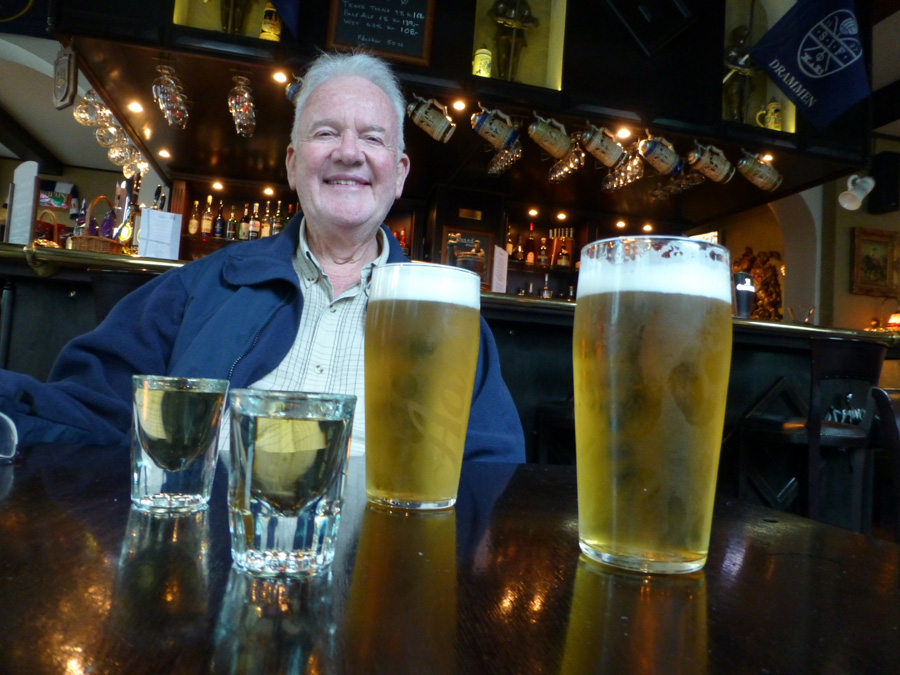
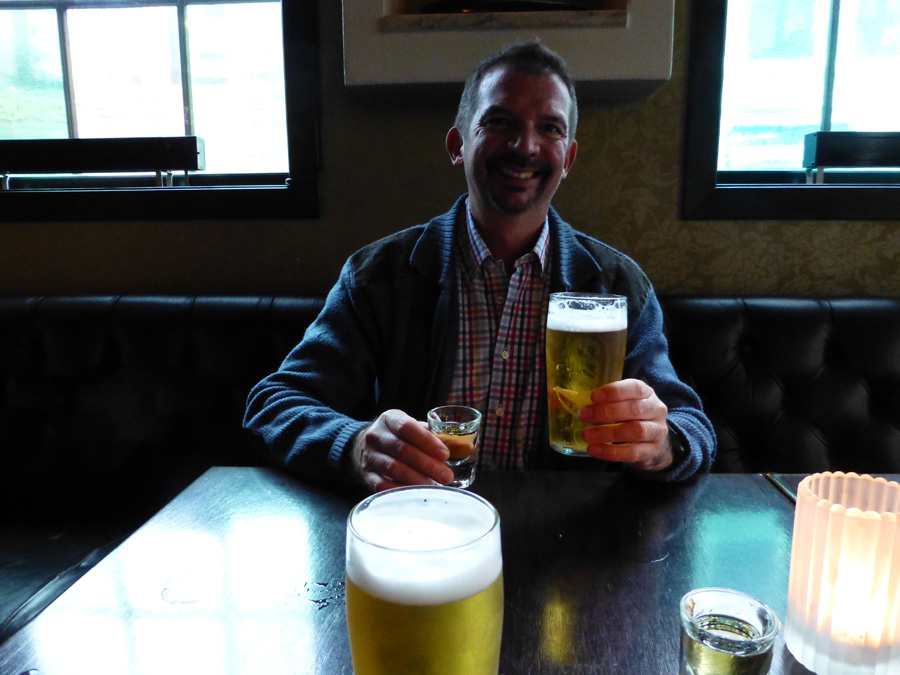
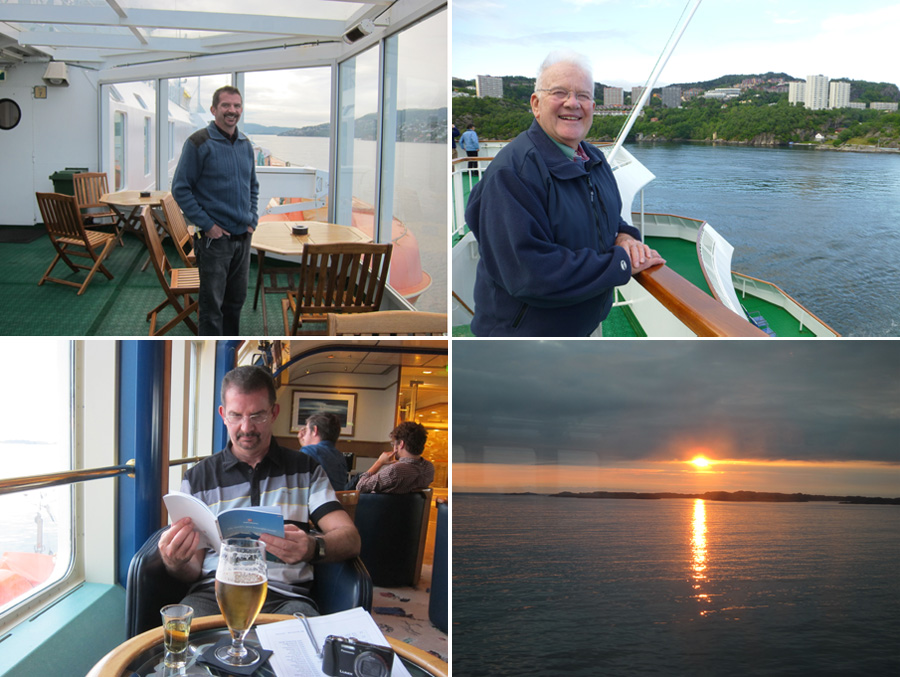
We each ordered a Pilsner and an Aquavit. I am smiling here, but that would soon change. We had finished the Aquavit and still had half a Pilsner left, so decided to get another Aquavit each. That was all we ordered.
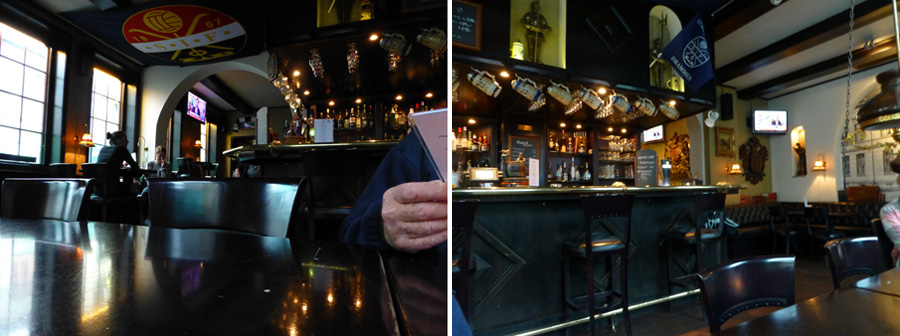
The pub did have a bit of atmosphere, and we were enjoying the peace and quiet, as there were only 4 other patrons besides us.
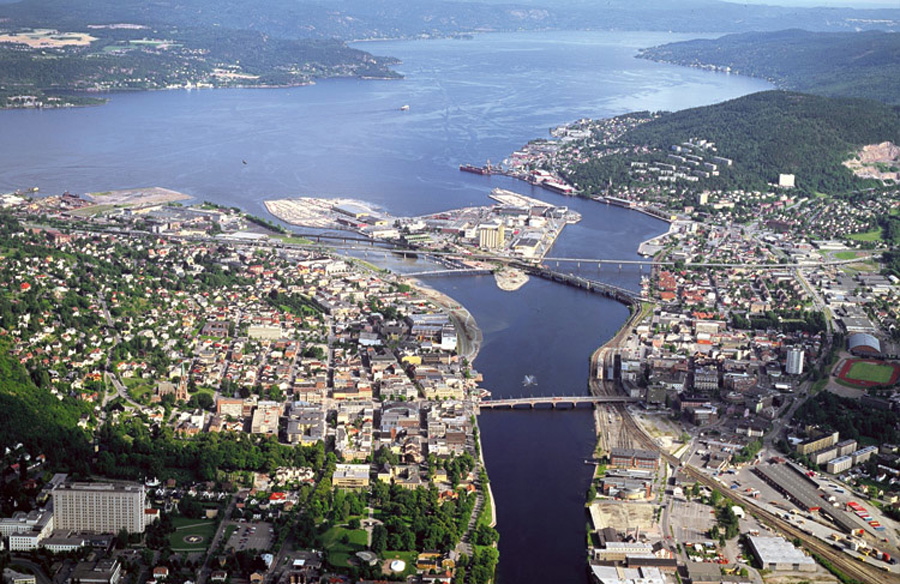
Pete was certainly enjoying himself. But we both had a long day and were ready to retire, so when we finished these drinks we asked for the bill. That’s when my smile vanished. It was 550 Kroners. At an exchange rate of 6:1 that meant that our drinks cost us nearly $92, before the tip. This was our introduction to the colossal prices we would encounter over the next twelve days. But before we leave Drammen, here is a nice aerial shot showing the fjord and what a great port city Drammen is.
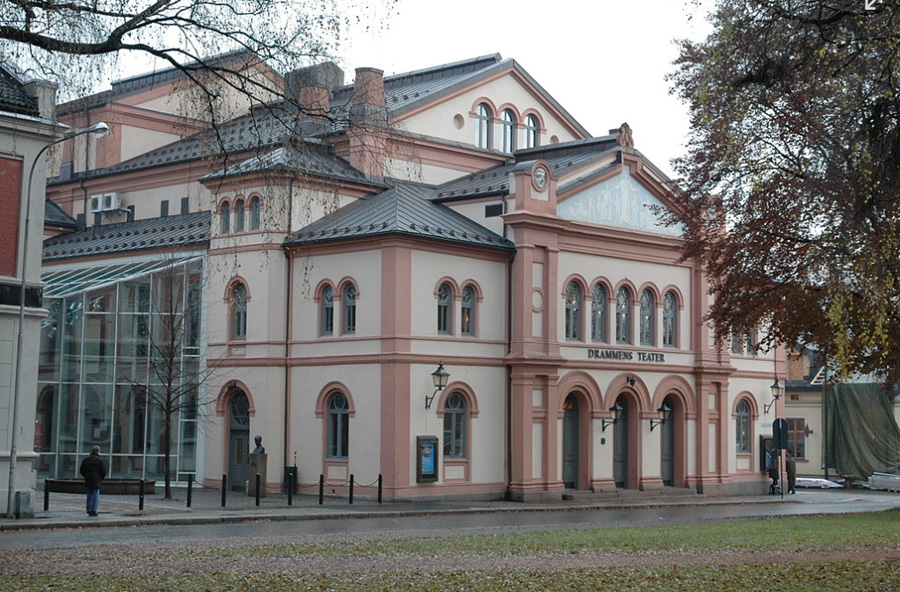
Culture has not been overlooked here. This is the very nice Drammen Theater, although they leave the ‘h’ out in their spelling of it. I wished that we had the time to see a performance there. Pete and I both love theater, as we had season tickets for years when we lived in Mountain View. We hardly go anymore, due to the language difference in Argentina. Come to think of it, a play here would probably have been given in Norwegian. ;o(
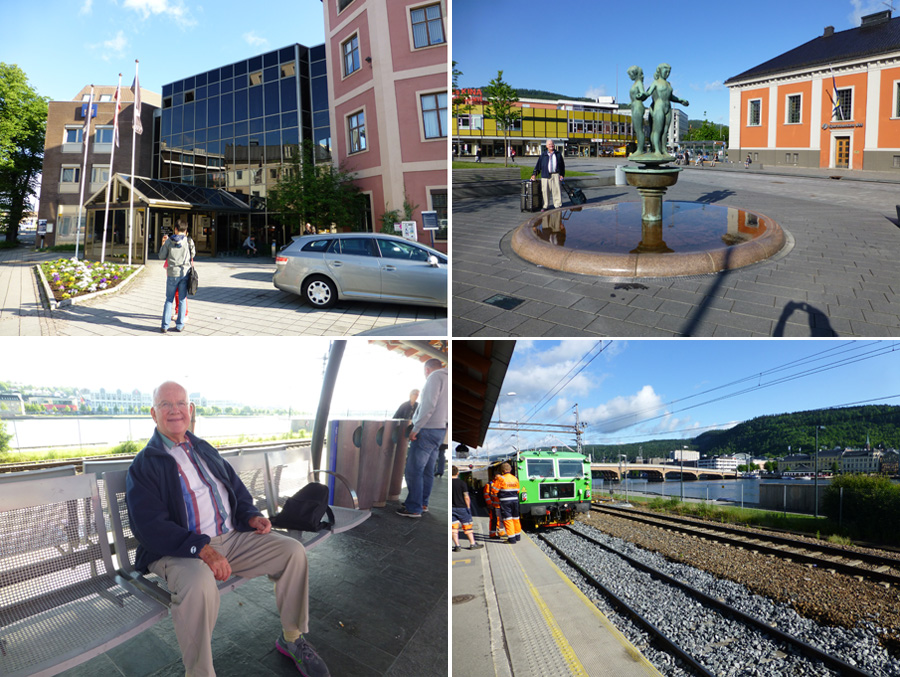
We had bought our train tickets to Bergen the day before, so all we had to do now was get a good nights sleep and pack in the morning, which was quite easy since we had not really unpacked. As we leave our hotel, the First Ambassadeur, Pete takes a photo of the entrance, and then turns around to take the photo of me with my suitcase. I am headed for the train station, the yellow building behind me. As you can see, the hotel was very close to the train station.
The wait was not long for our train, and it wasn’t that green car. That is a maintenance car with workers for mending the tracks when needed. They obviously are doing a fantastic job because our seven hour ride to Bergen was very smooth and comfortable.
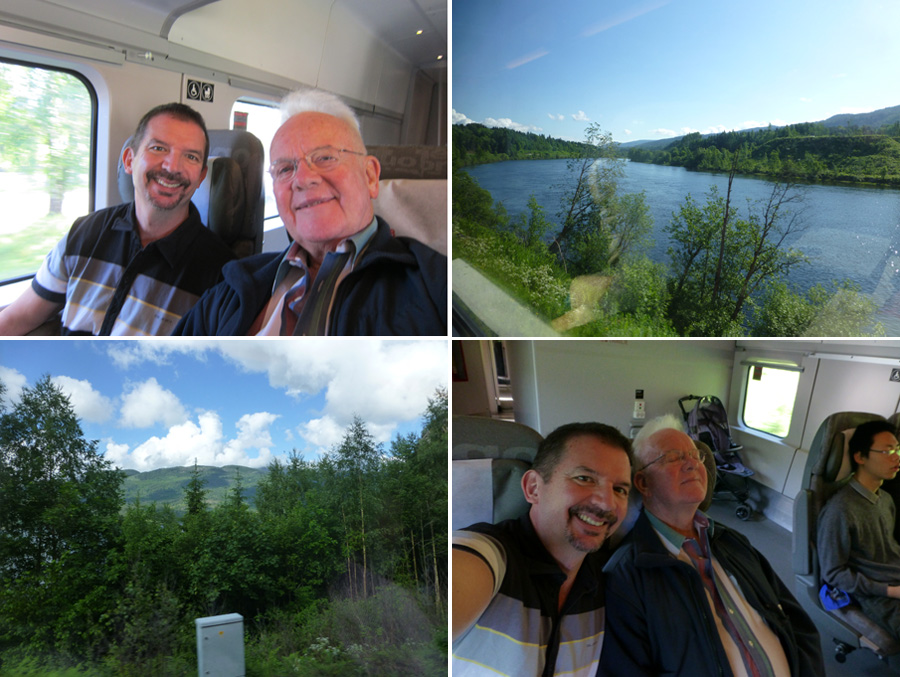
The train followed a river for much of the trip. The country side was like emerald, so lush and green. It was easy for me to drift off, and leave it to Pete to capture it for posterity. ;o)
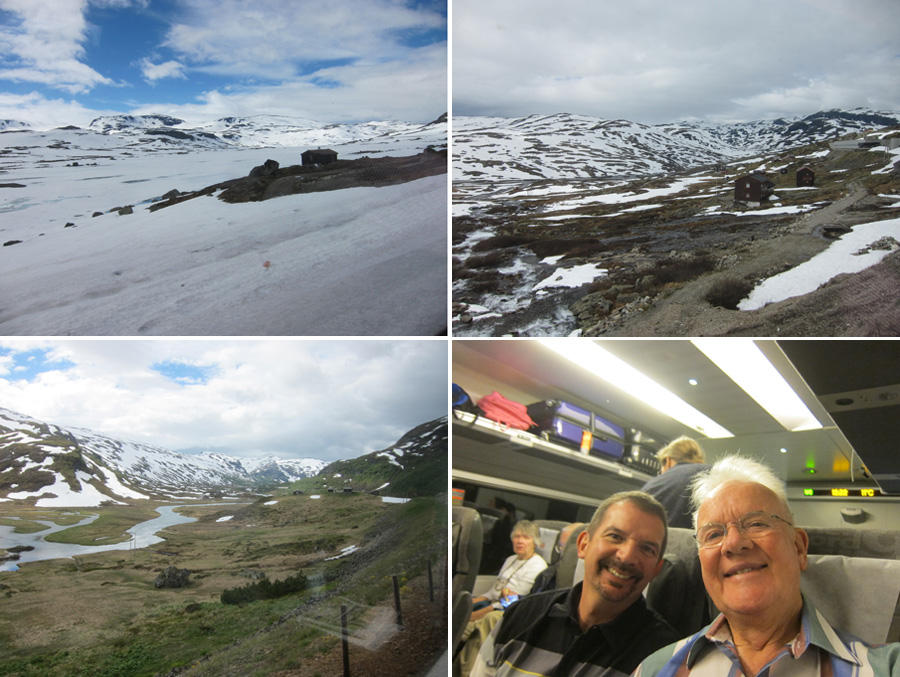
As we neared bergen, the terrain changed considerably. A Norwegian we met on the ship told us that the climate has changed a lot over the past several years. It used to be that by fall all of the snow had melted off the mountains, but for the past several years the mountains remained snow covered throughout the year, right up until it began snowing again. This seems more like global cooling to me, rather than global warming, but I’m not a ‘scientist’, so what do I know.
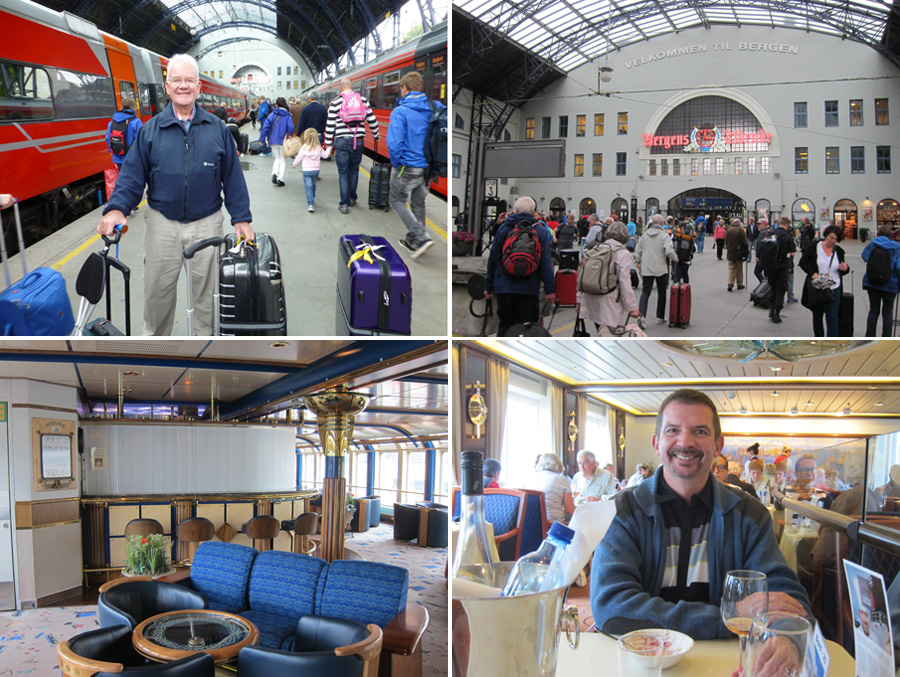
We finally arrive in Bergen. The train station is impressive. We head outside to find a taxi to get to the dock where our ship is tied up. Once on board, the first thing we check out is the lounge. They provided a buffet dinner that evening, and we could sit anywhere we wanted. After that, we had an assigned table for the evening meals. Breakfast and lunch were open seating. I actually preferred breakfast and lunch because it was buffet style, and you could choose anything you wanted. I definitely had my fair share of smoked salmon, and herring in a multitude of delicious sauces, not to mention the caviar, black, red and white. I discovered that Norway really knows how to make bread. It was wonderful. There was also a warm berry cobbler for dessert, besides ice cream and an assortment of cakes. This was hardly a time to be on a diet. Diets are for when you are at home, and have more control over your appetite. At least that was a very convincing argument for me. ;o)
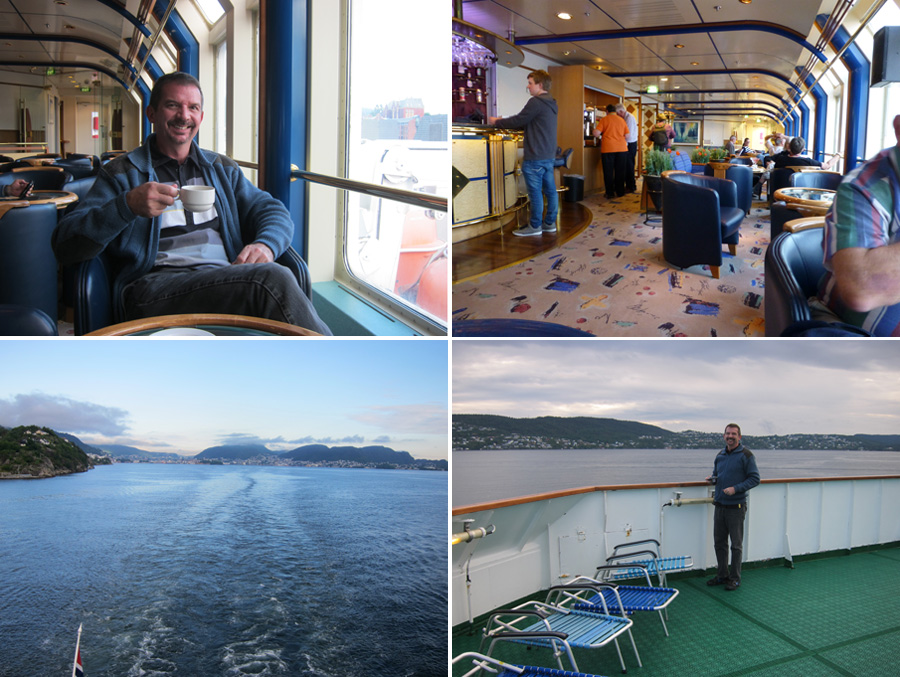
They do not serve coffee in the dining room accept for breakfast. After dinner you have to retire to the lounge where there is a great coffee machine next to the bar. As we steam away from the beautiful city of Bergen, Norway’s second largest city, we go out on deck to explore our ship a little more.
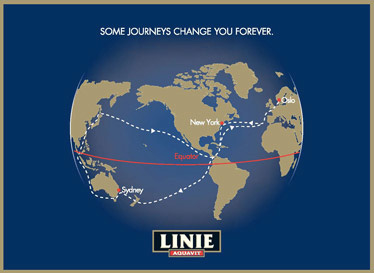
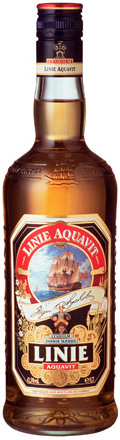
There was lots of deck space, and a track for jogging on the upper deck. No, I didn’t use that. ;o) The ’sunset’ shot above is similar to what we would be seeing every night as we went further north. This time of year the sun never sets once we are above the Arctic Circle. After getting a little better acquainted with our home for the next 12 days, we then retire back to the lounge, where we enjoyed a pilsner and aquavit, a very satisfying combination we learned of from Elis many years ago in Mountain View. She told us the story of Linie Aqjuavit, how in 1798 Heinrich Meincke, a trading manager and his sister Catharina Meincke, commissioned a brig named Trondhjems Prøve. In 1805 the boat was loaded with stockfish, hams, cheeses and what was otherwise considered to be of interest in Batavia (Indonesia). On board was a cargo of five casks of Norwegian aqua vita. The captain failed to sell his cargo of spirits. Drinking customs and taste were different in Batavia. Home again in Trondheim in December 1807 the barrel bungs were extracted and the goods sampled once again. The changing conditions inside the oak barrels had had a marked impact on the spirit — thus the principle behind Linie aquavit was established. Although sailing ships are a thing of the past, Linie still crosses the equator twice. Every month fresh batches of matured oak barrels depart on a 19-week passage visiting more than thirty-five countries. The equator is crossed twice and it is always a ship from Wilhelmsen that is used for the freight. The aquavit, which has a 60 percent alcohol content, is stored in oak barrels on deck in containers. During the passage, fluctuations in temperature and humidity influence the maturing process, while the constant motion of the sea swirls the aquavit around in the barrels. More than one thousand barrels of Linie are at any given time maturing as deck cargo on the worlds oceans. Each bottle of Linie aquavit carries a description of its worldwide sailing route via Australia on the rear side of the label, stating the departure and arrival dates. The maturing process is vital and starts with the import of 500-litre oak sherry barrels from Jerez. The barrels were previously used for producing oloroso sherry for ten to fifteen years. The barrels give the aquavit its golden color; the residual matter from sherry provides a pleasant sweetness, and the white American or Spanish oak adds tones of wood and vanilla. Linie aquavit is something you have to try to really appreciate. And that is my challenge to everyone reading this. Enjoy!
|
|
||||
|