 |
|
|
|
|
|
|
|
|
|
|
||||||||
|
||||||||||||||||||
|
Email us at: |
||||||||||||||||||
 |
||||||||||||||||||
 |
 |
|||||||||||||||||
|
Click the sun to see the |
||||||||||||||||||



|
 |
|
|



|
|
|
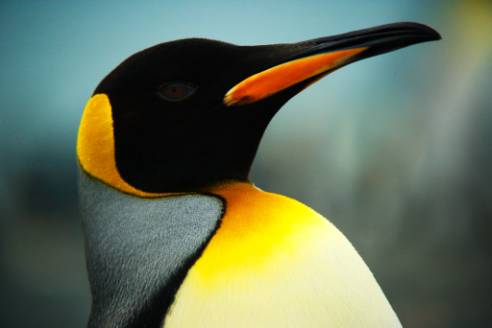
DAY TEN ST. ANDREWS BAY & GRYTVIKEN WHALING STATION Carved gold in the middle of her cheeks, her dishy commas shimmer in the sun -excerpt from King Penguin, Diane Ackerman
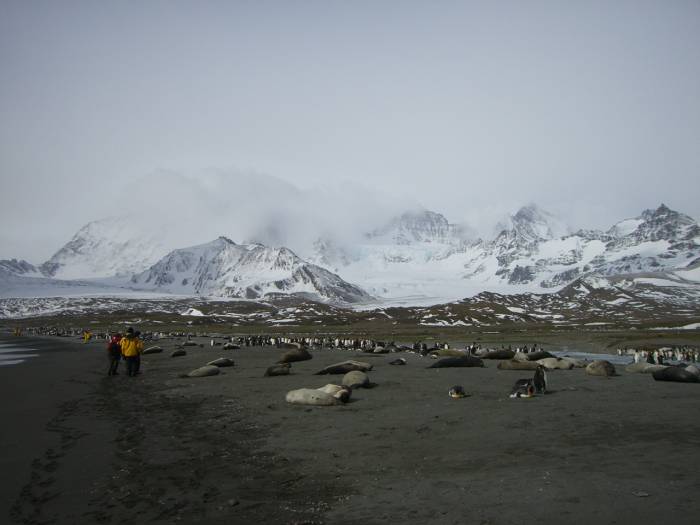
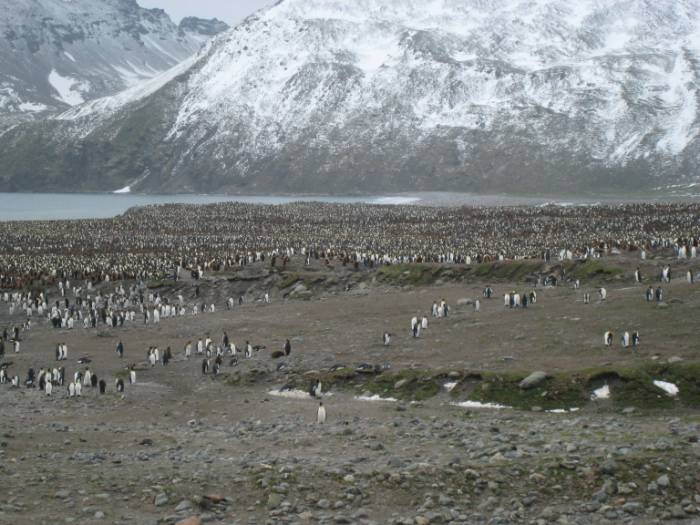
Isn’t Mother Nature simply amazing to have created such a beautiful creature, and so specialized? Breakfast was at 6:30 this morning because we were to land at St. Andrews Bay at 7:30. Not much time to eat and then get suited up for the landing. St. Andrews Bay is fully exposed to the open sea and to the strong winds that plummet from the ice-clad summits of the southern end of the Allardyce Range, where 2,000 m (6,500 ft) summits of Mt. Roots, Mt. King, Nordenskjold Peak and Mt. Brooker for a superb backdrop to the largest concentration of King Penguins and Elephant Seals on the island. The King Penguin colony (approx. 500,000) borders the banks of the river that flows from the Buxton and Cook glaciers.
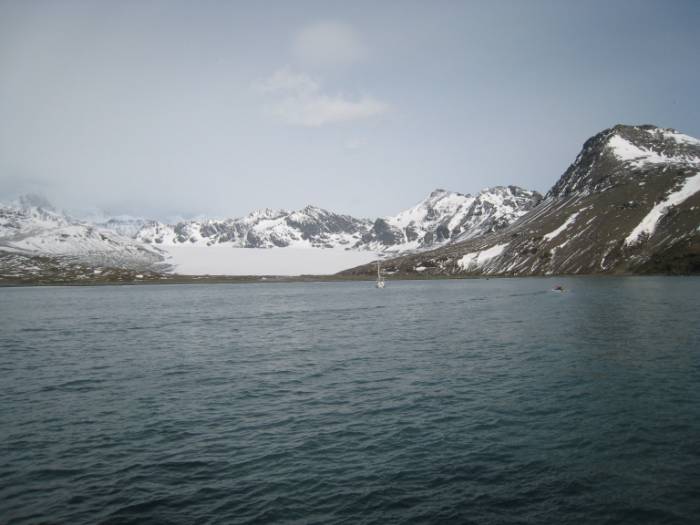
Here we are at anchor off St. Andrews Bay. It looks relatively calm, and you can see The bay was probably first sighted by the British expedition under Cook which explored the north coast of South Georgia in 1775. The name dates back to at least 1920 and is now well established. The King Penguin colonies are continuously occupied because of the long breeding cycle. The chicks remain in their brown downy feather coats for over a year, and never go into the water to feed, but are fed by their parents this entire time.
Because of the calm seas the landing was quite easy.
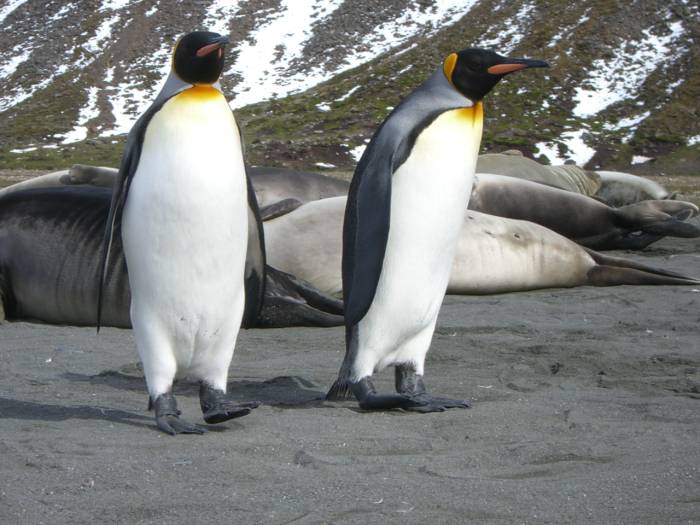
We were greeted by a pair of King Penguins, who appeared curious about our presence.
We had quite a walk ahead of us to get to the main body of the King Penguin colony.
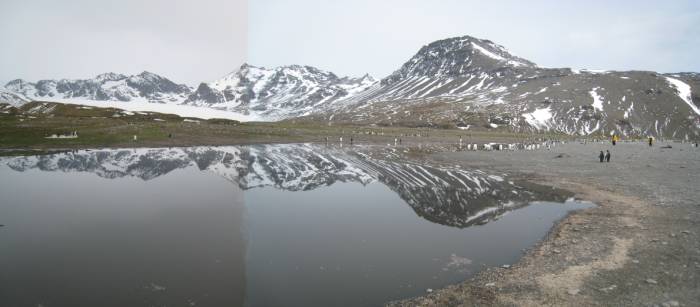
The river we are headed for is at the edge of the snowfield in the distance. You can see
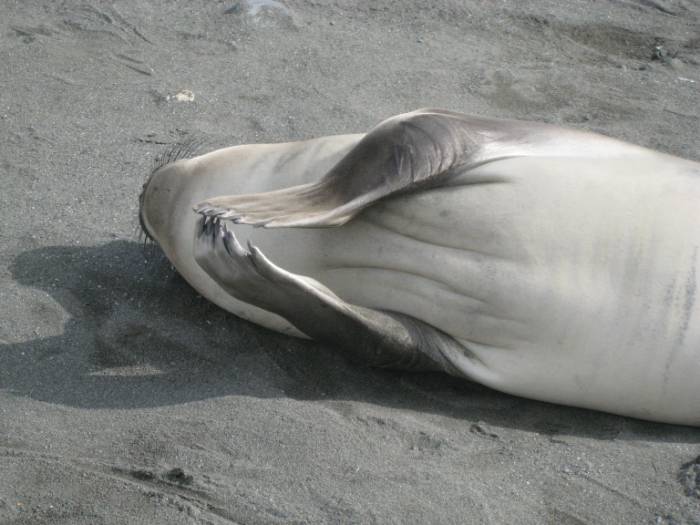
An Elephant Seal pup scratches an itch with his slaws. Just look at that blubber.
We’re about half way there. I brought sunglasses as well, but I felt I was
The scenery was absolutely breath taking. Sorry I couldn’t figure out how to blend the colors
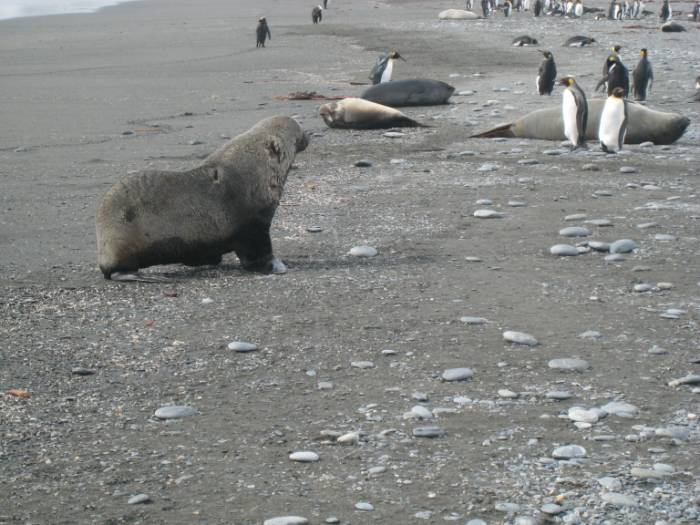
We came upon a Fur Seal bull making his way from the water to higher ground.
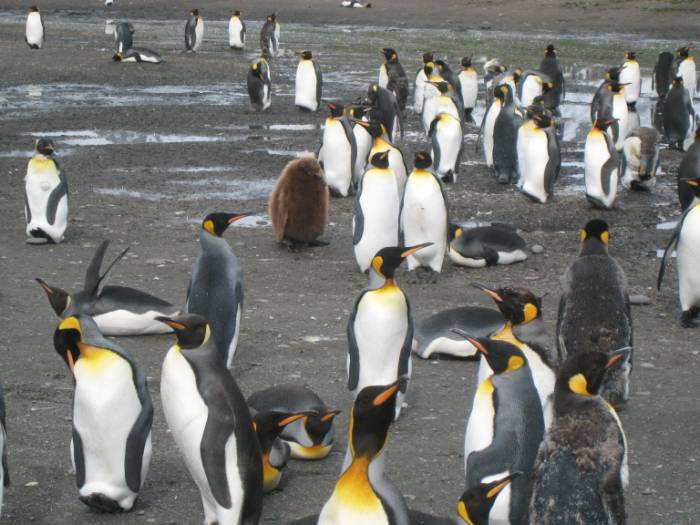
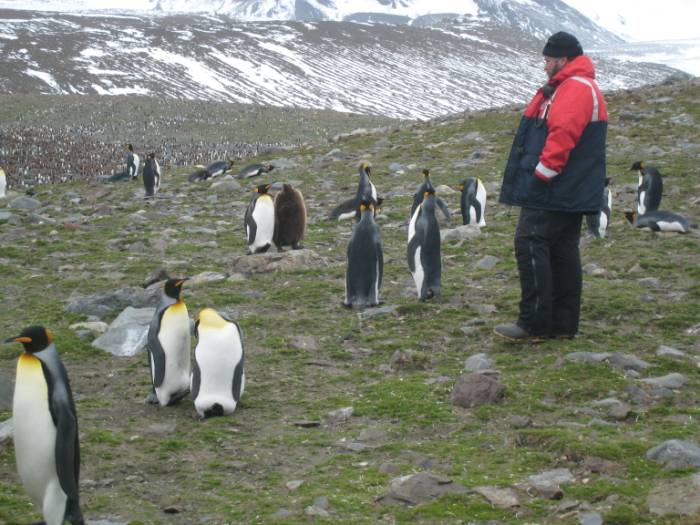
We are walking among the King Penguins, and the brown one at center has not yet
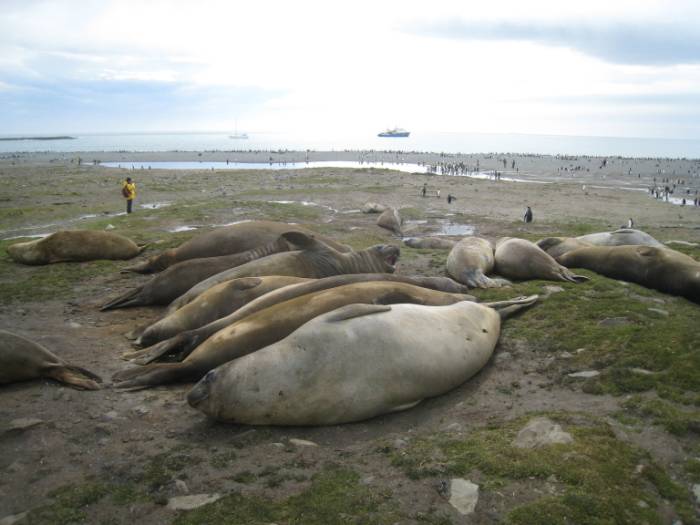
As you can see, the Elephant Seals haul themselves quite a way up from the shore.
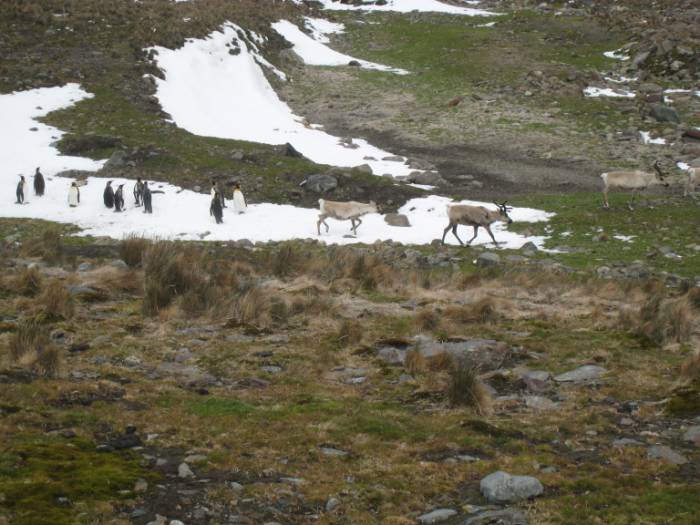
In our hike to the main part of the rookery we come upon a small herd of Reindeer.
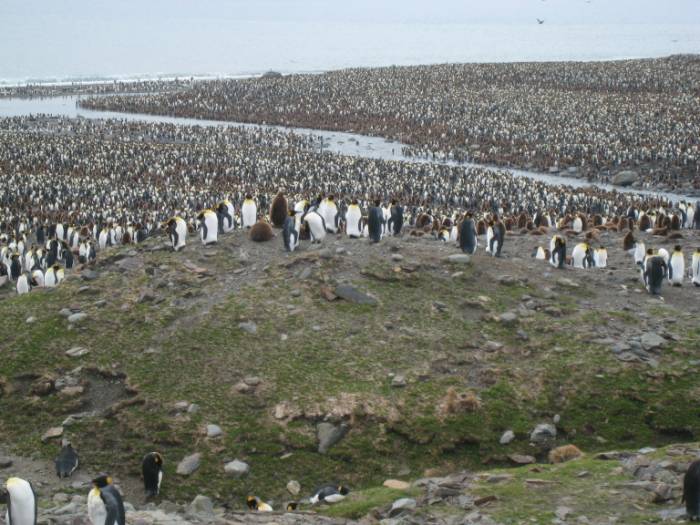
This is the main body of the St. Andrews Bay rookery, but it stretches down to the sea
You frequently see them crossing the river, which has quite a strong current, and they King Penguin’s average height is 94 cm (37”) and weigh in at 13.5-16 kilos (30-35 lbs) and have a lifespan of 15 to 20 years. They feed by deep-water pursuit diving, using their flippers to propel themselves to depths of several hundred feet. Dives may last 15 minutes or more. Their diet includes small fish and squid, krill, and plankton. King Penguins are unique in that they have an unusually long breeding season. At any one time chicks of various ages are present in the colonies as eggs are laid anytime from November through April. From courtship through hatching of the eggs to the fledging of the chick may take 14 months or more making annual breeding impossible. Like the Emperors, King Penguins’ eggs are incubated on the adults’ feet and not in nests. Both parents share in the care of the egg, which takes approximately five weeks to hatch. Just as a comparison, Emperors on average stand 1.2 m (48”) tall and weigh up to 40 kg (88 lbs). They have a life span of up to 50 years.
And there’s Shane, our Expedition Leader, getting up close and personal with a couple
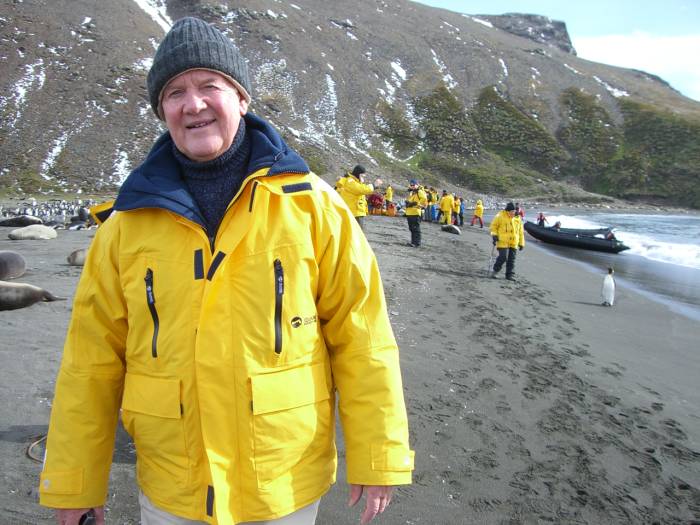
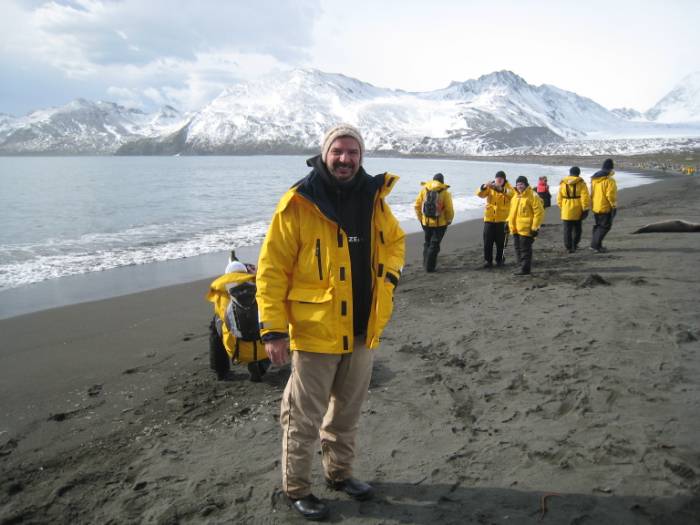
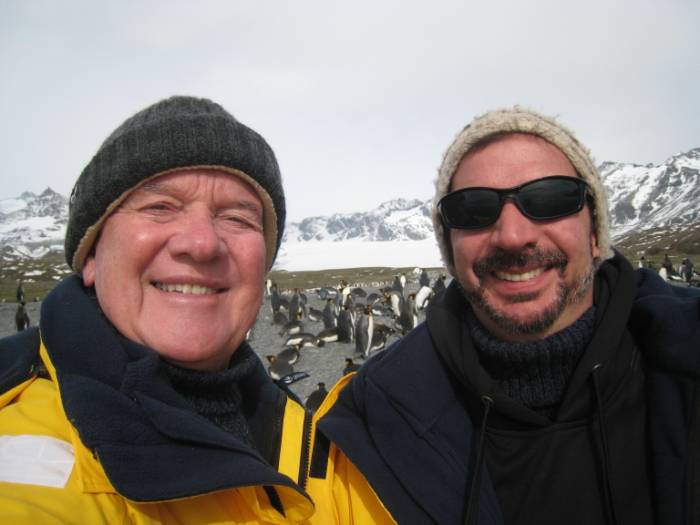
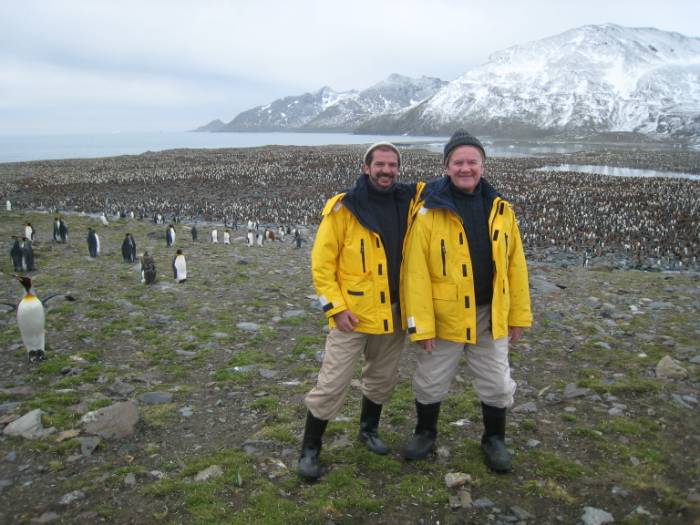
Just to prove that we were really there, we had someone take this photo for us.
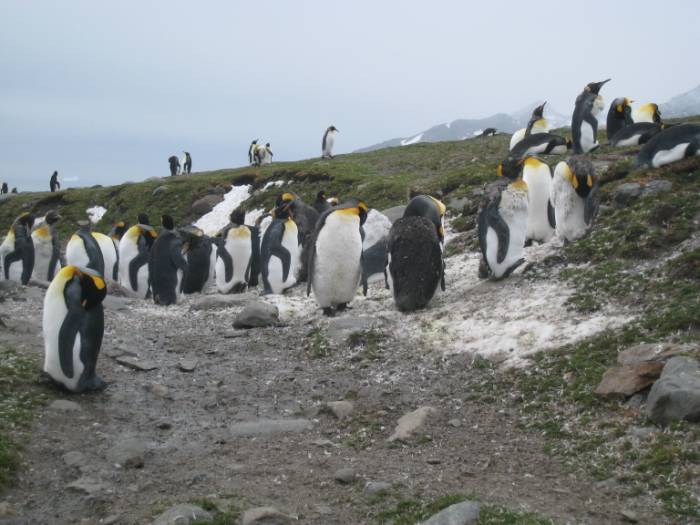
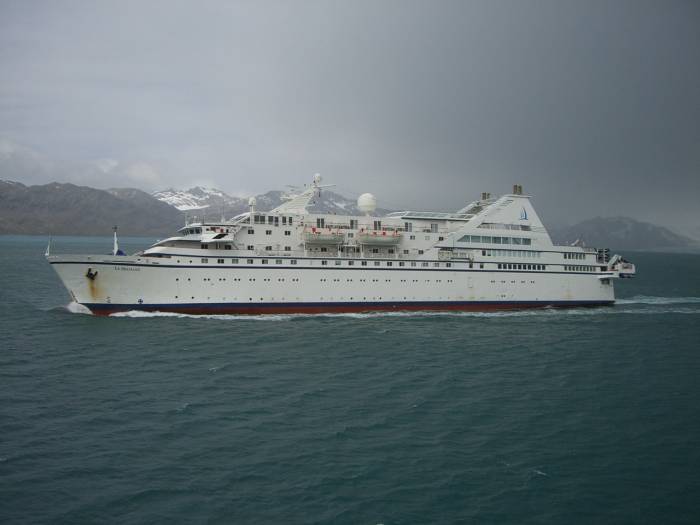
Man, it must really itch when those old feathers are molting. They were all keeping their On our way from St. Andrews Bay to Grytviken, we passed by this ship, Le Diamant (not a Quark ship). The sister of one of our staff was on this ship, and we all went up on deck to wave as it went by, and the captain gave them a blast of salute from our ships horn.
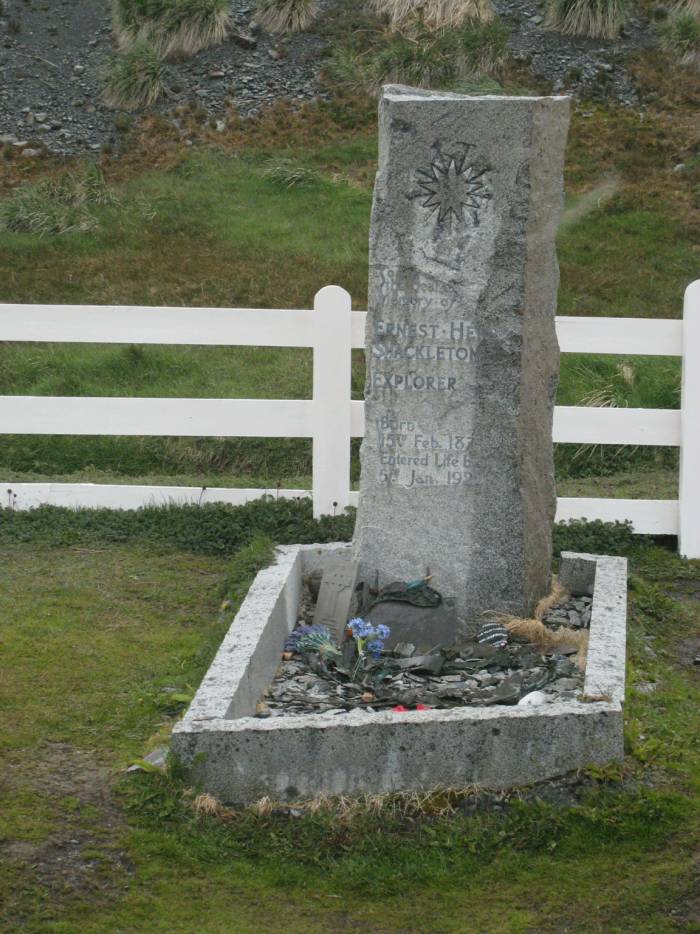
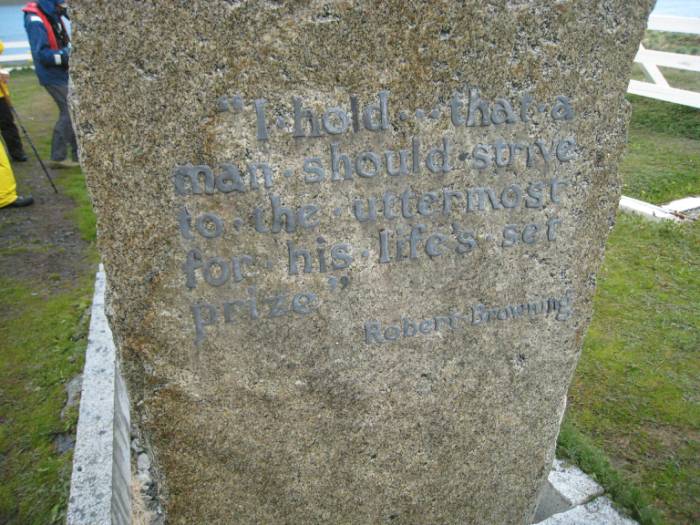
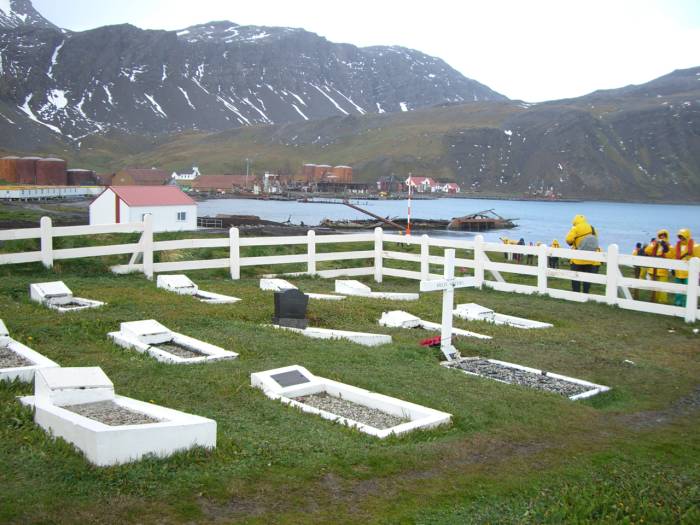
We were so glad that we were on a much smaller ship. Forty-eight is a nice size group. Grytviken, on the east coast of South Georgia in sheltered King Edward Cove, was the first shore-based whaling station to be established in the Antarctic. On 16 November 1904 the Norwegian Captain C. A. Larsen arrived at Grytviken with a steam-powered whale catcher, Fortuna, and two sailing ships, Louise and Rolf. Several buildings, a slipway and a factory equipped with blubber cookers were erected so quickly that whaling operations started five weeks later. In the first year, 200 whales were caught. The station produced whale oil, sperm oil, seal oil, meat meal, bone meal, meat extract, and in it’s final years, frozen whale meat. Whaling continued at Grytviken without a break through two World Wars. As many as 300 men worked an October to March ‘season’ at the station during it’s heyday, they came mainly from Norway, but also from Buenos Aires and the Falkland Islands. Another 700 men were spread around other stations at Leith, Stromness, Husvik, Ocean Harbor, Godthul and Prince Olav Harbor. Norwegian whaling ceased at Grytviken in 1962, but between 1963 and 1965 the station was leased to a Japanese company. Whaling ended at Grytviken in 1965 simply because the whale stocks had become exhausted. The Whalers’ Cemetery is the resting place of mainly whalers, but there are also a few graves of 19th century sealers. The latest is of Felix Artuso, an Argentine sailor from the submarine Santa Fe, the only victim from the 1982 conflict between Britain and Argentina to be buried here. Sir Ernest Shackleton was buried March 5, 1922 with his head oriented south towards Antarctica, instead of east like the others. The reverse side of his granite gravestone bears one of his favorite quotations, from Robert Browning: ‘I hold that a man should strive to the uttermost for his life’s se prize’.
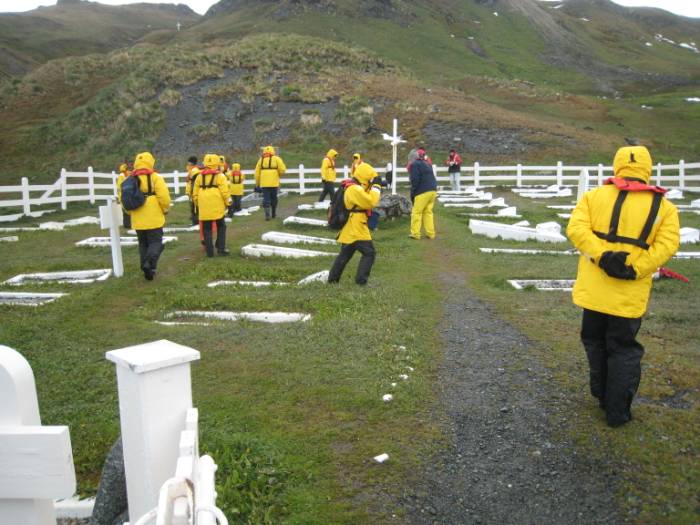
This is the Whalers’ Cemetery.
The grave of Sir Ernest Shackleton. I thought it was quite a modest marker for
The Robert Browning quotation on the backside of the tome stone.
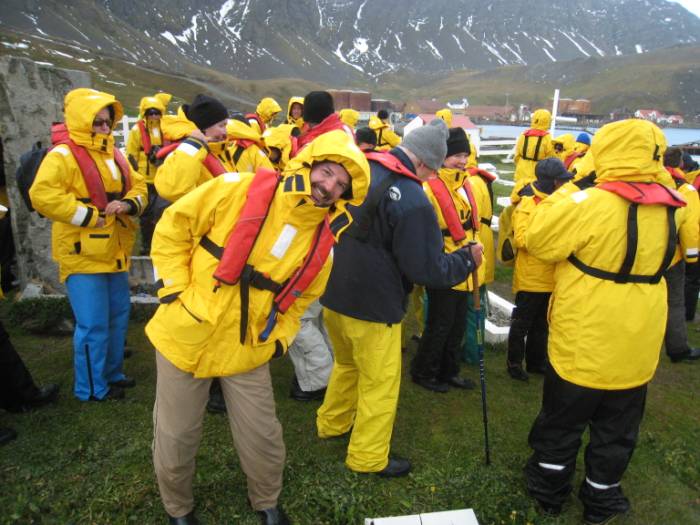
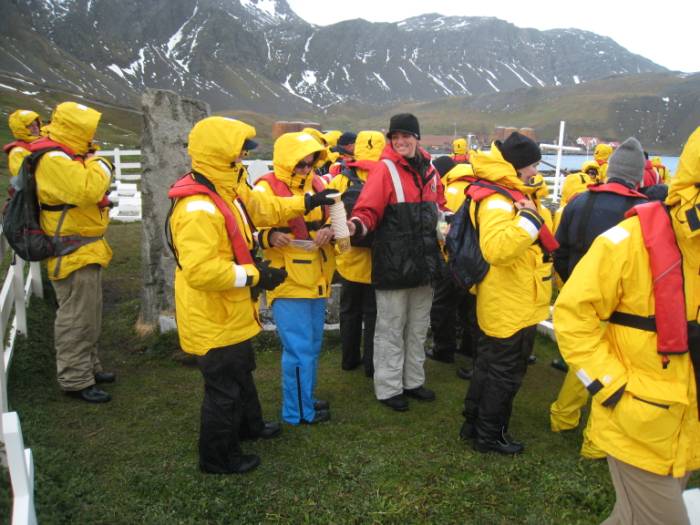
We gather around Sir Ernest’s graveside, as it is the custom to make a toast to his memory.
Hanna, the ship’s bar tender had brought paper cups and a bottle of scotch for the occasion.
We then headed for the whaling station, the Whalers’ Church and the Whaling Museum.
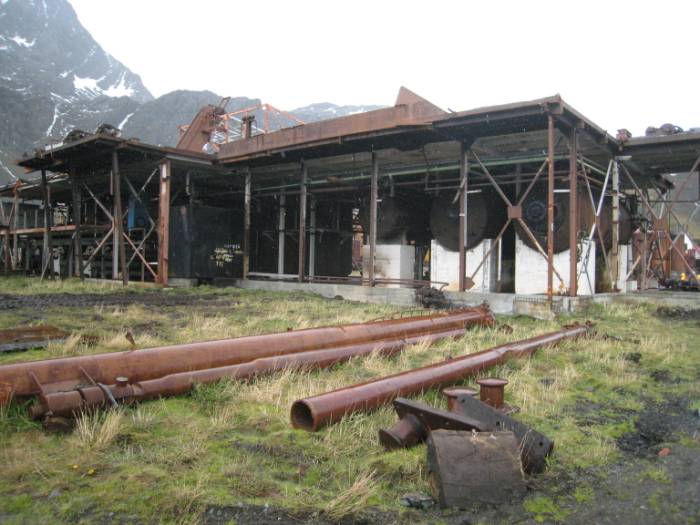
This was the “Meal Plant”. Meat meal and bone meal were collectively called whale meal Meat and bone residues (‘grax’) arrived from the adjacent Meat and Bone cookeries and Separator Plants after the oil had been extracted. They were fed separately into five cylindrical rotting ovens. As the meat and bone residues passed along the ovens they were simultaneously dried by hot gases blown in from oil-fuelled furnaces and crushed into meal. After leaving the oven, the meal went through a crushing mill and cyclone separator that filtered meat and bon dust from the hot gases. Finally, the meal was stored in bags, in a huge L-shaped shed until an overhead conveyor took them to a cargo ship. Baleen plates, or whalebone, were initially a valuable product used in brushes, hats, corsets, fishing rods and many other applications, but they were gradually replaced by plastics. Eventually baleen was the only part of the whale not utilized.
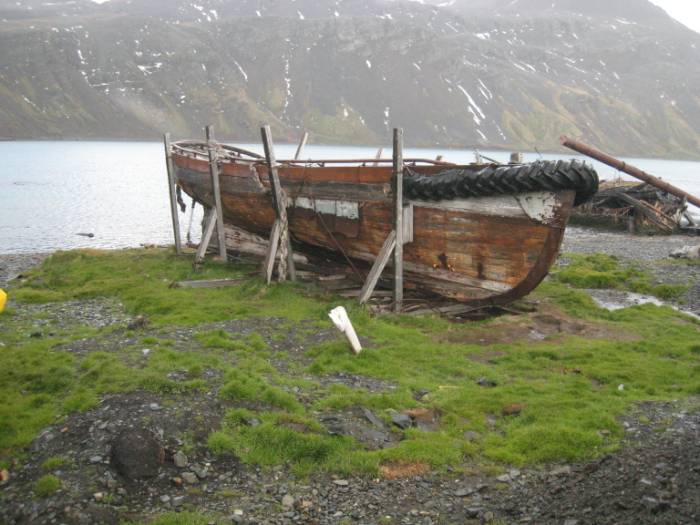
An old whale boat in dry dock. Note the tractor tire used as a fender. Interesting how
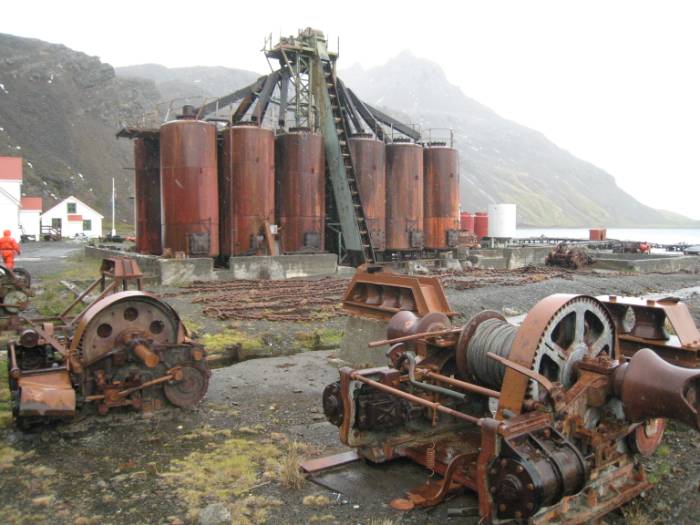
The blubber cookery, where oil was extracted from the whale blubber in two rows of 12
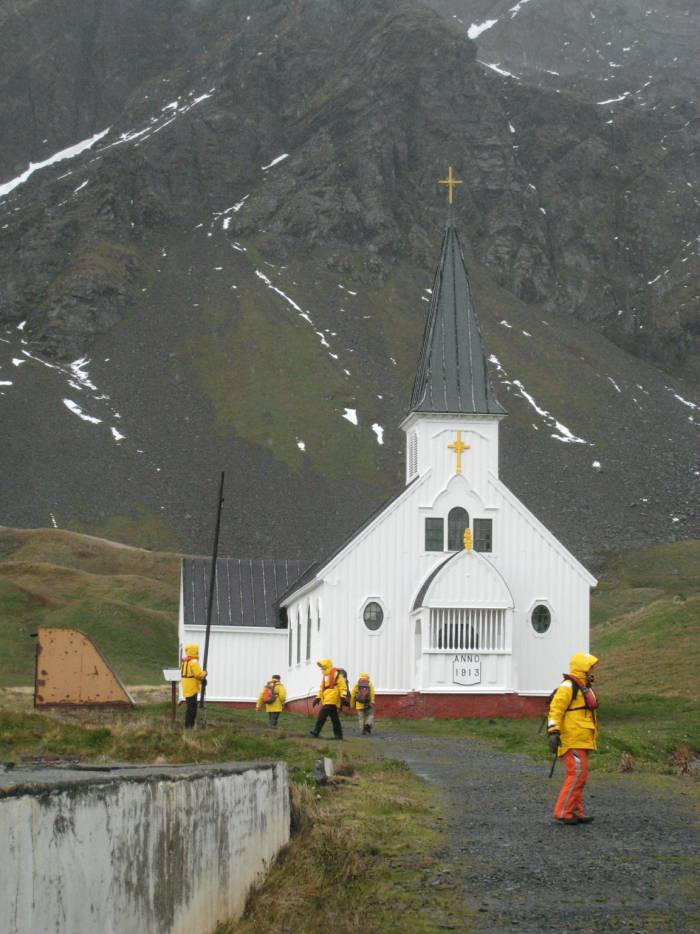
The Whalers’ Church, a Norwegian Lutheran Church, was prefabricated in Norway
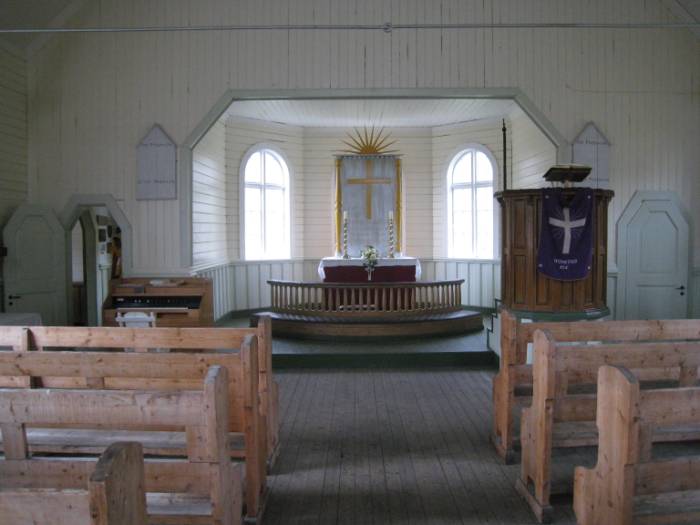
Quite simple but very functional, as I suspect most Lutheran churches are.
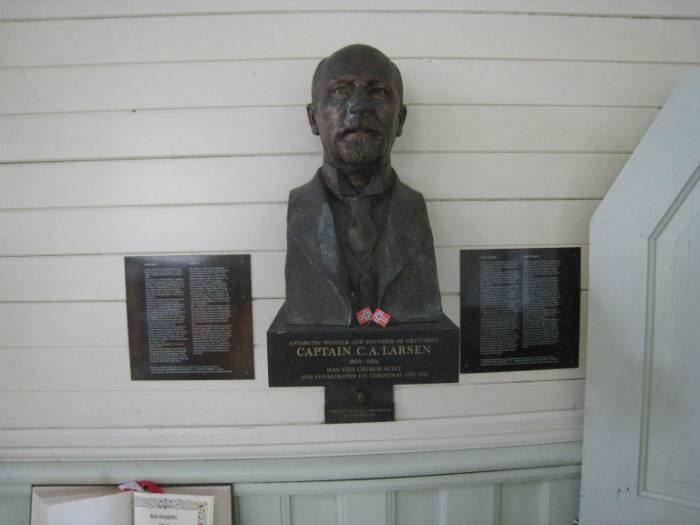
The Norwegian, Captain C.A. Larsen, was the builder of this church.
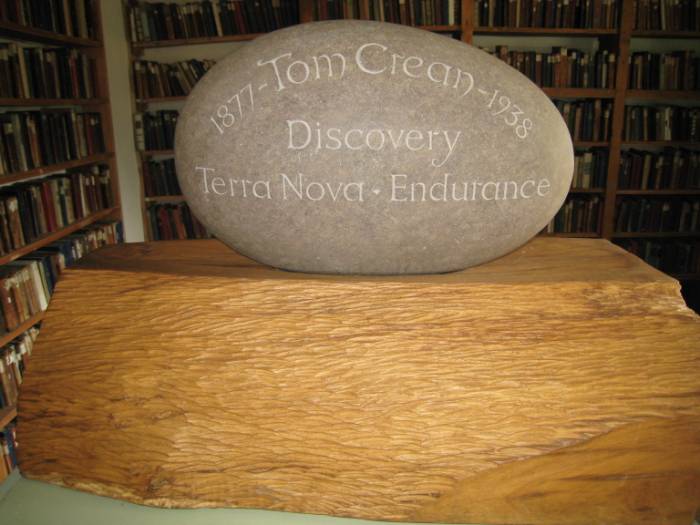
This huge granite stone monument to the memory of Tom Crean, resides in the
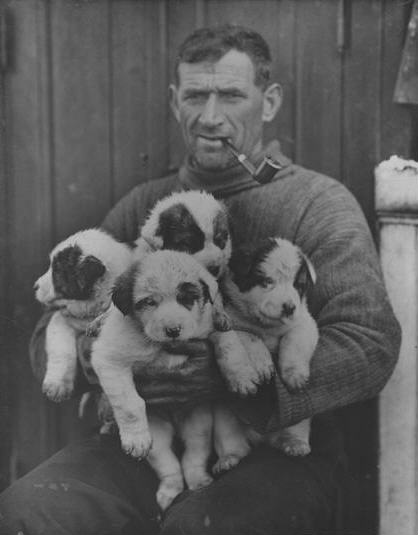
Tom Crean with sled dogs in 1915 Tom Crean (explorer) From Wikipedia, the free encyclopedia Tom Crean (20 July 1877 – 27 July 1938) was an Irish seaman and Antarctic explorer from County Kerry. He left the family farm near Annascaul to enlist in the British Royal Navy at the age of 15. In 1901, while serving on HMSRingarooma in New Zealand, he volunteered to join Robert Falcon Scott's 1901–04 British National Antarctic Expedition on Discovery, thus beginning a distinguished career as an explorer during the Heroic Age of Antarctic Exploration. Crean was a member of three of the four major British expeditions to Antarctica during this period. After the Discovery Expedition he joined Captain Scott's 1911–13 Terra Nova Expedition, which saw the race to reach the South Pole lost to Roald Amundsen, and ended in the deaths of Scott and his polar party. During this expedition Crean's 35-mile (56 km) solo walk across the Ross Ice Shelf to save the life of Edward Evans led to him receiving the Albert Medal. His third Antarctic venture was the Imperial Trans-Antarctic Expedition on Endurance led by Ernest Shackleton, in which he served as Second Officer. After Endurance became beset in the pack ice and sank, he was a participant in a dramatic series of events including months spent drifting on the ice, a journey in lifeboats to Elephant Island, and an open boat journey of 800 nautical miles (920 statute miles, 1,500 km) from Elephant Island to South Georgia. Upon reaching South Georgia, Crean was one of the party of three, which undertook the first land crossing of the island, without maps or proper mountaineering equipment. His contributions to these expeditions earned him three Polar Medals, and a reputation as a tough and dependable polar traveler. After the Endurance expedition Crean returned to the Navy, and when his naval career ended in 1920 he moved back to County Kerry. In his hometown of Annascaul, he and his wife Ellen opened a public house called the "South Pole Inn". He lived there quietly and unobtrusively until his death in 1938.
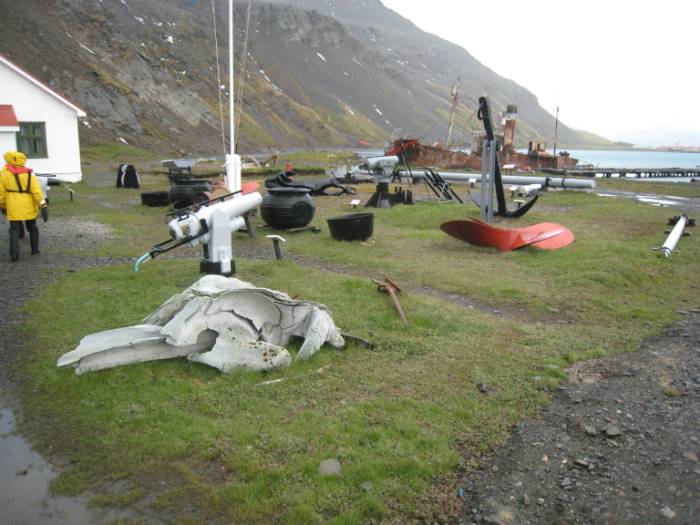
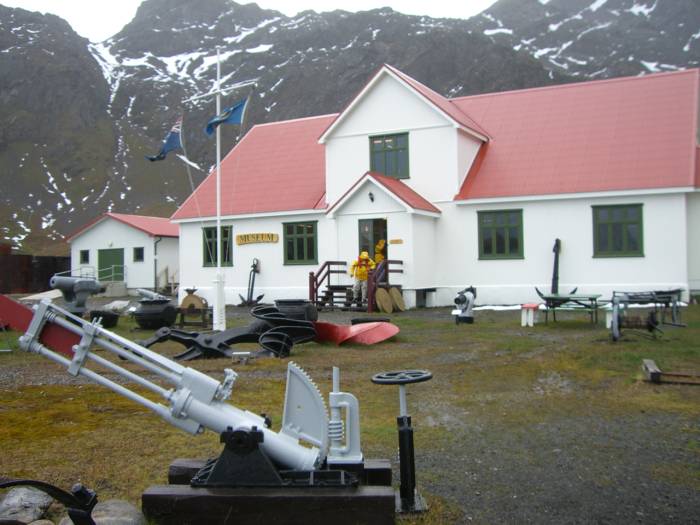
The grounds of the museum at Grytviken have an amazing array of whaling artifacts.
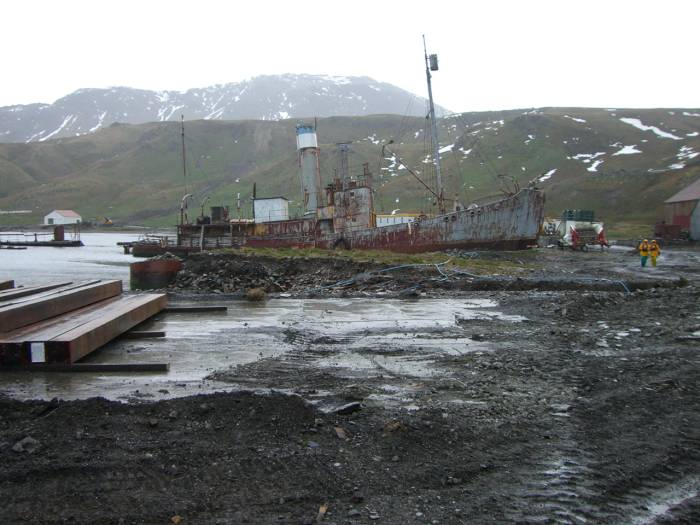
Like this old whale catcher, now hauled out of the water, a monument to our past.
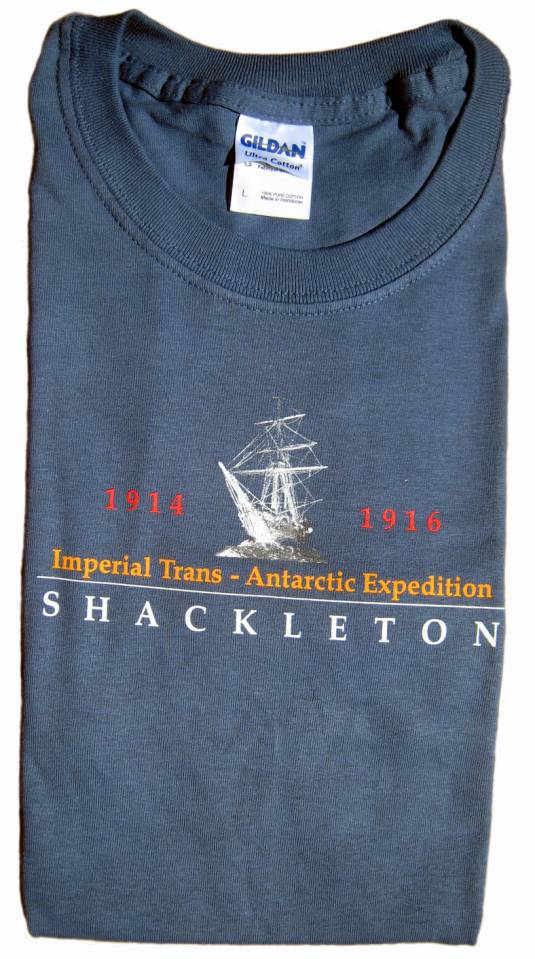
The museum itself was quite large, and there was a great gift shop, where I bought a cool Endurance T-shirt.
The T-Shirt I bought in the Museum gift shop. I also mailed 12 postcards
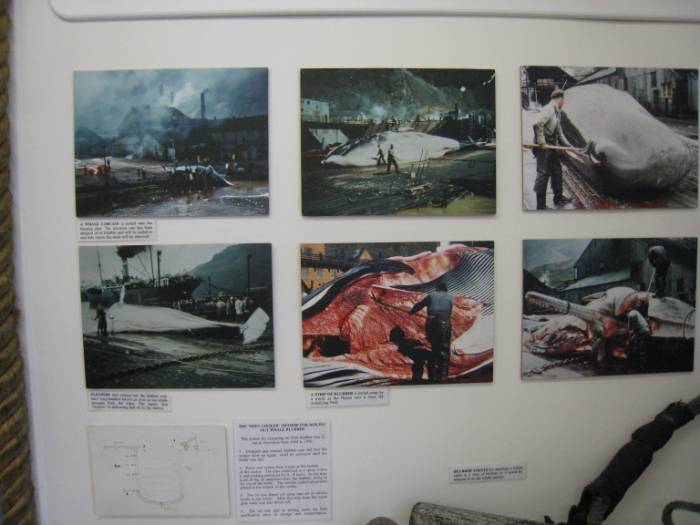
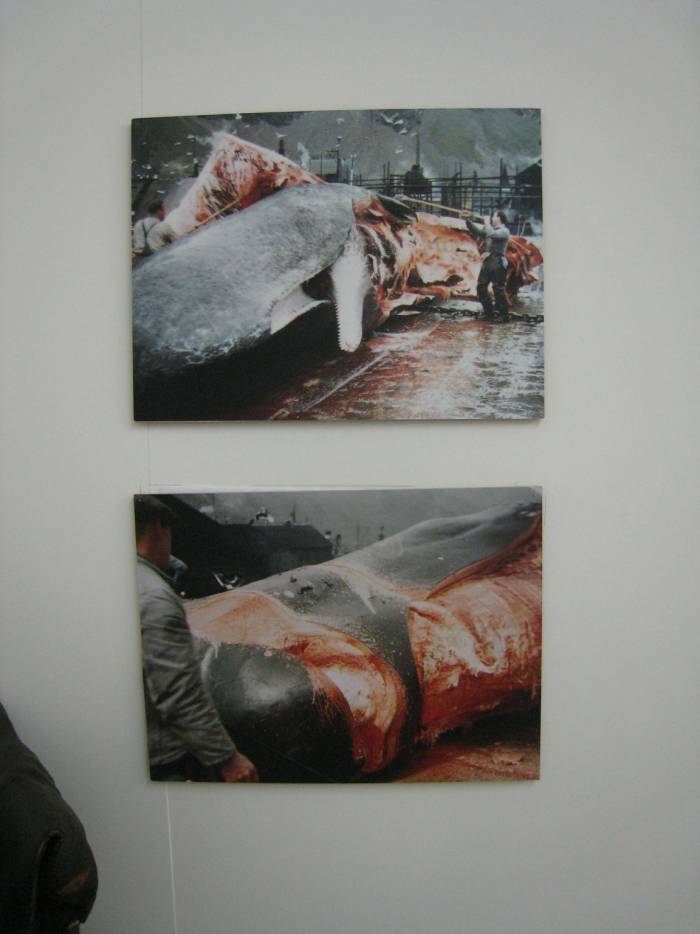
Inside the museum there were some pretty graphic photographs of the whaling process.
They really make you feel sorry for the poor whales. I’m so glad it is generally banned.
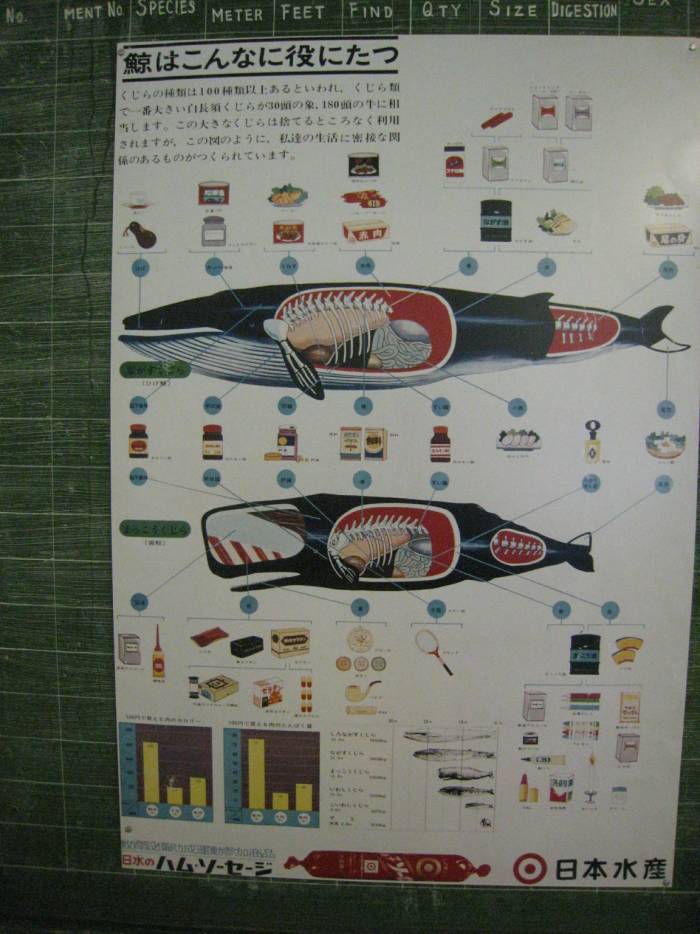
This poster was left behind from when the Japanese leased the station in 1963 to 1965.
There were even Sperm whale teeth and the eyeball of a whale. This concludes our visit to the museum at the Grytviken Whaling Station. Next we proceed to Gold Harbour.
|

|
||||
|