 |
|
|
|
|
|
|
|
|
|
|
||||||||
|
||||||||||||||||||
|
Email us at: |
||||||||||||||||||
 |
||||||||||||||||||
 |
 |
|||||||||||||||||
|
Click the sun to see the |
||||||||||||||||||



|
 |
|
|


|
|
||
|
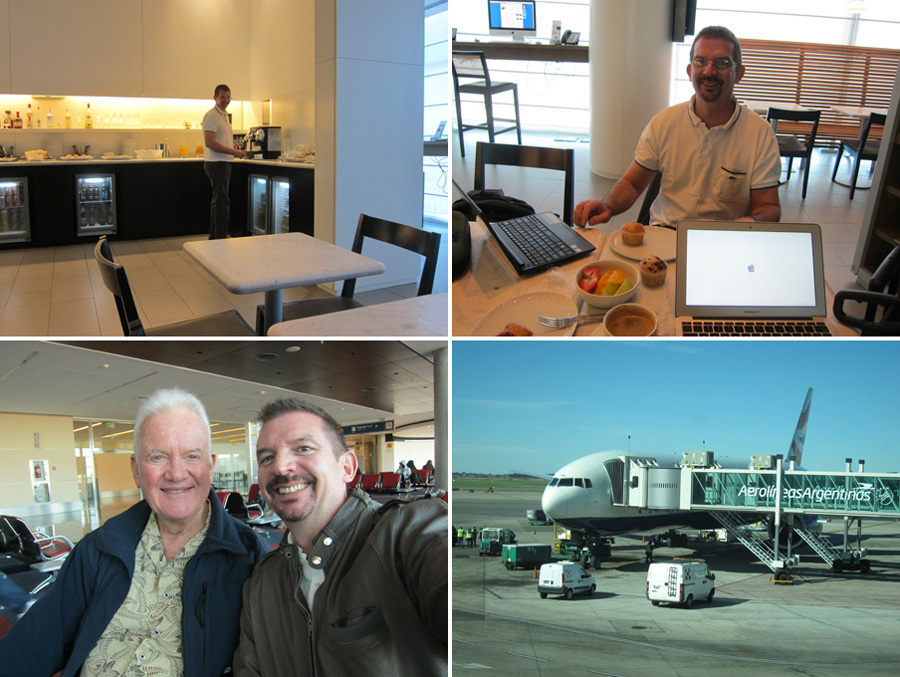
Hi! It's me again. A while back I did something I had never done before, I tried to create the travelogue for our trip to Alaska on the Grand Princess last June, in one message, and it became rather large, like over 20 mbytes, and I hoped that it would not present a problem for anyone's mail server. Well, I think that it may have been a problem for many, so I have broken it up into 5 separate and more manageable messages. If you did NOT receive my original attempt to send the whole thing, please let me know if you would like to receive it now, and I will make a list of those who respond and send it again, but in five smaller and more manageable messages. If I do not hear from you, I will assume that you were able to handle the larger message, and will not add your name to a list of those to receive the five smaller messages. And of course, as always, there is this disclaimer, which will allow you to opt out of receiving further chapters of this travelogue, or any future travelogues. Simply send me a message and ask to opt out, and your name will be permanently removed from my travelogue list, no questions asked. In the meantime, I hope you will enjoy his first part of our July/August trip to Amsterdam, on Viking River Cruises Grand European Tour, from Amsterdam to Budapest. It's only 4.9 MB, and I will keep any that follow under 5 MB. Pete and I had been looking forward to this trip for a long time. And, spending the time with Pete's mom and his Aunt Cindy was like icing on the cake. We left home on the 23rd of July, a Tuesday, so traffic was light getting to Ezeiza. This allowed us an hour or so for the VIP lounge, where we could get coffee and muffins, etc., and do some e-mail catching up on our computers. We left the house at 9:30 AM for our 1:00 PM flight, 13 hours 20 minutes to London's Heathrow, a 2 hour layover then a 1 hour 10 minute flight to Amsterdam where the local time was 10:40 AM on Wednesday, 24 July.
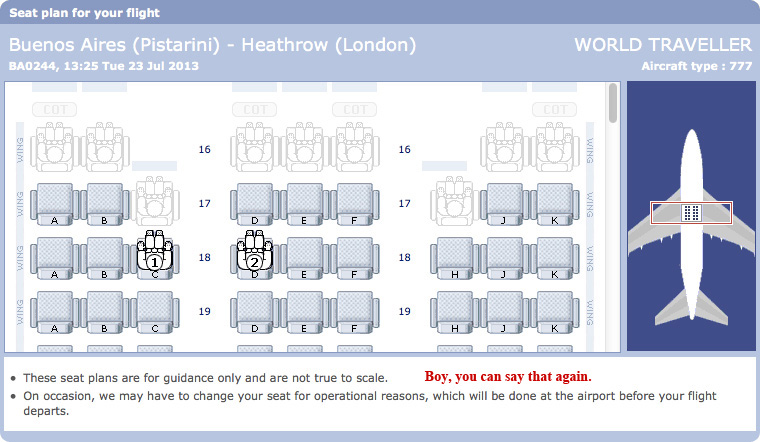
We finally went to the gate just before boarding was called. We were flying on a British Airways 777, and we each had
The plane took off pretty much on time, and it was a pretty nice flight. The meals are a cut above the fare we normally get on American Airlines, and the stewards were more generous with the free drinks as well. Also, when you select a movie, it starts for you at the beginning. On American you either come in on the middle of a movie, or queue it up to start at the beginning in some arbitrary number of minutes. That's a very annoying "feature" When we landed in Amsterdam, we were told to look for a red shirted Viking representative. Easier said than done, because the terminal was so huge. We finally asked another tour representative and we were told that we should look near gate 2. We were at gate 5. Pete went ahead and found her, and brought her back to where I was waiting with our luggage. We had to wait a short while for other passengers from other flights to find there way to us, and then we were all led to a waiting bus to take us to the ship.
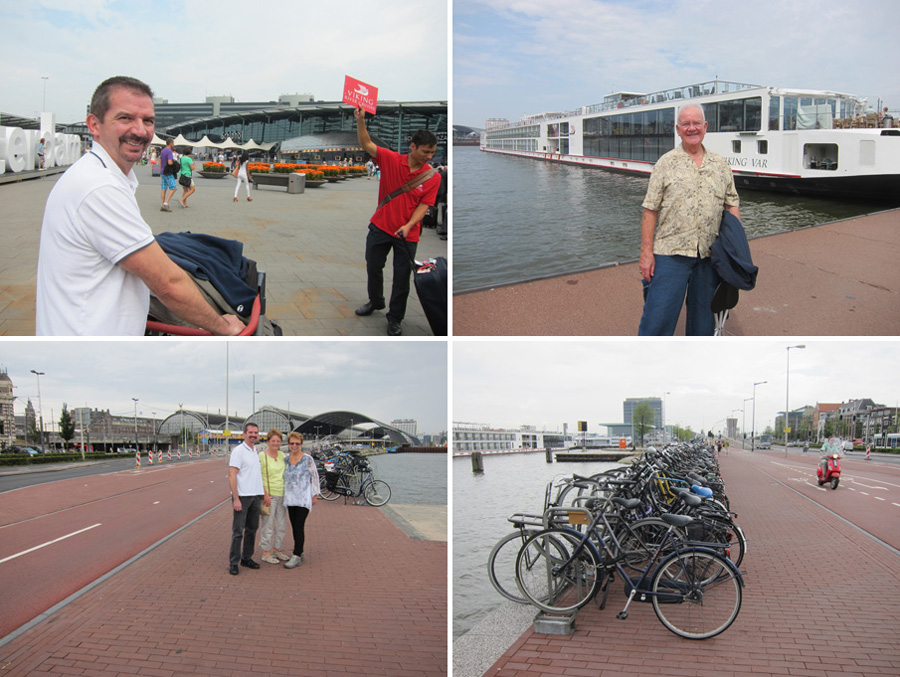
Pete's mom and his Aunt Cindy were on a Delta flight which landed an hour after our flight. It didn't take us long to find them, as I was sitting in the lounge with a huge picture-window view of the dock as they got off their bus and walked to the gangway. Pete was off on a city walk-about with a local tour guide. Six months earlier we had booked the Viking Longboat "Freya". (And when they say Longboat, they mean it. See the photo of me standing in front of the Var above. The boat seems to trail off approaching infinity.) Two days before we were to leave home, we received an e-mail from Viking saying that our ship has been changed to the Viking Longboat "Var". The reason for this was that in Germany the lock workers were on a rolling strike, and they would randomly close a lock for a period of time, causing major havoc on the movement of ships up and down the river. A few weeks earlier the Freya was caught in such a lock strike, and it was met by the Var on the other side of the lock and heading in the opposite direction, towards Budapest. Since they were sister ships, they just swapped passengers from one ship to the other, with each passenger going to the same identical cabin on the other ship, and the Var turned around and went back to Amsterdam, while the Freya turned around and went back to Budapest. We were told at our first briefing that we might have to do the same thing at some point of our journey. That didn't sit too well with many of us, because the thought of packing our bags and moving to another ship was an inconvenience nobody was looking forward to. But I will talk more about that later on. We boarded the boat in early afternoon, and the chef had a magnificent Embarkation Buffet prepared for us. It was great. Our first day in Amsterdam (July 24th) just happened to be my birthday, and Pete's mom's birthday is on July 25th. We had planned to have only one party, on the 25th, so that night at dinner when the waiters brought me a cake with a few lit candles, I was very surprised. Of course they all had to sing Happy Birthday to me in their various European accents. Pat gave me a gift of Sees chocolates (she knows me so well). Aunt Cindy gave both Pete and I a pair of the zaniest and colorful striped socks.
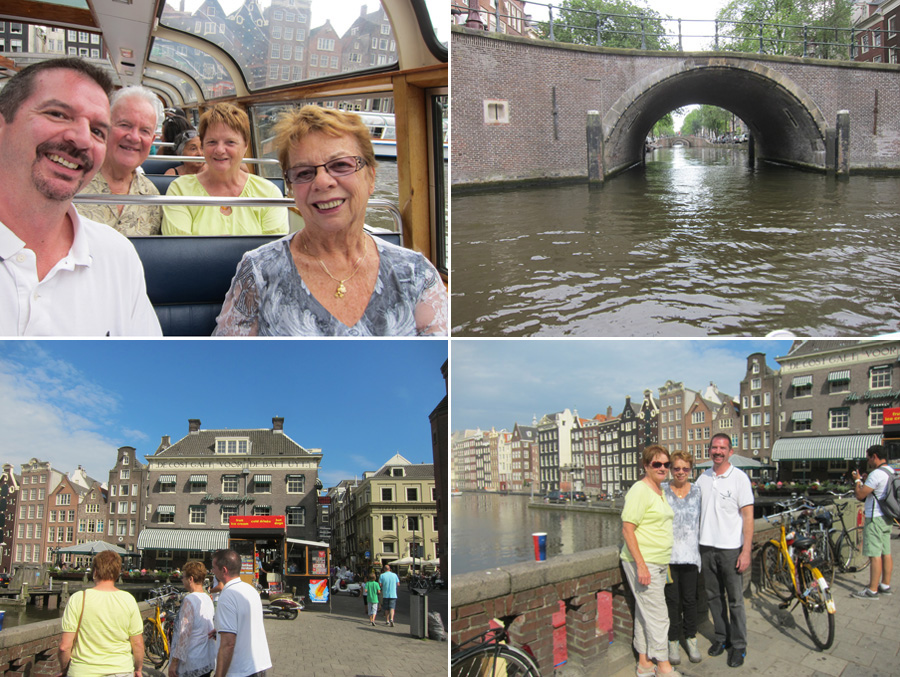
I'm going to love wearing mine. And on the following night the party was repeated for Pat. But before all this took place, and since we wouldn't be casting off until 11:30 PM, we took a walk around the city with Pete as our guide. He knew exactly where to take us since he had gone on the walk earlier with a guild. He said it was a brisk walk that even wore him out, so I was glad I stayed on board to watch for the arrival of Pat and Cindy.
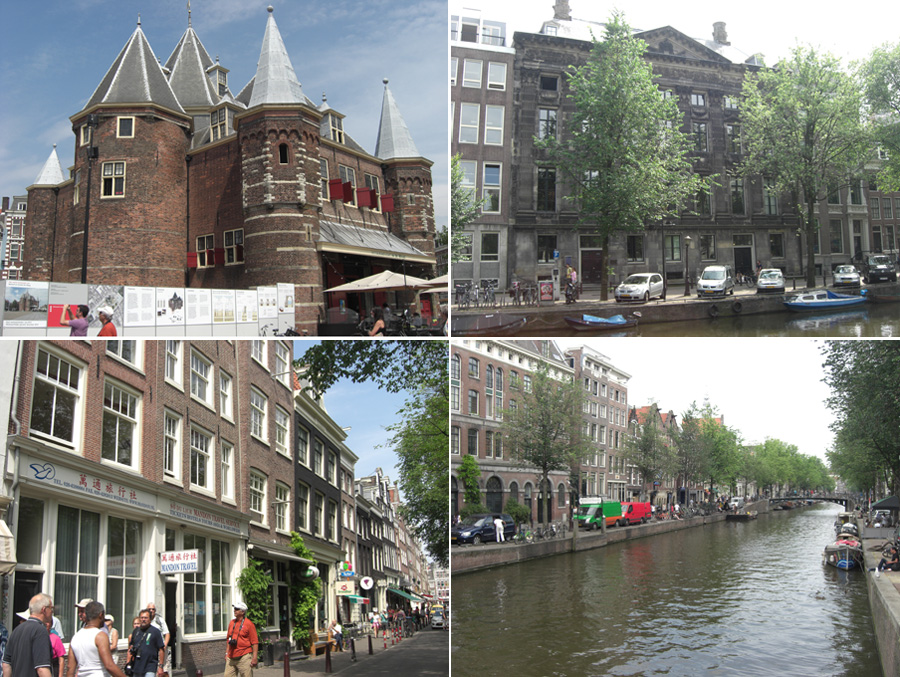
Take a look at a the hundreds of bikes in frame one. This is a sure sign that we are in Amsterdam. The kingdom of the Netherlands covers 14,413 square miles, or roughly the size of the states of Massachusetts and Connecticut combined. Much of the western region is either at or below sea level, with many tracts of land—known as polders—reclaimed from the sea. The following is a short bit of Dutch history. In the Middle Ages, the entire region consisted of autonomous duchies and counties. Even though a Spanish monarchy ruled the area known as the Low Counties, the merchants of this seaside region were busy trading herring, wool and furniture—and amassing their wealth. Perhaps seeing the potential for power, Prince William of Orange led a rebellion against the Spanish crown in 1568, beginning what would become the Eighty Years' War. With the 1648 Peace of Westphalia, the Netherlands won independence. In the years following, it built a vast overseas empire and became the world's leading maritime power. The Dutch East India Company grew their wealth from spice trade with India and Indonesia, and ships sailed as far away as today's Sri Lanka to establish colonies.
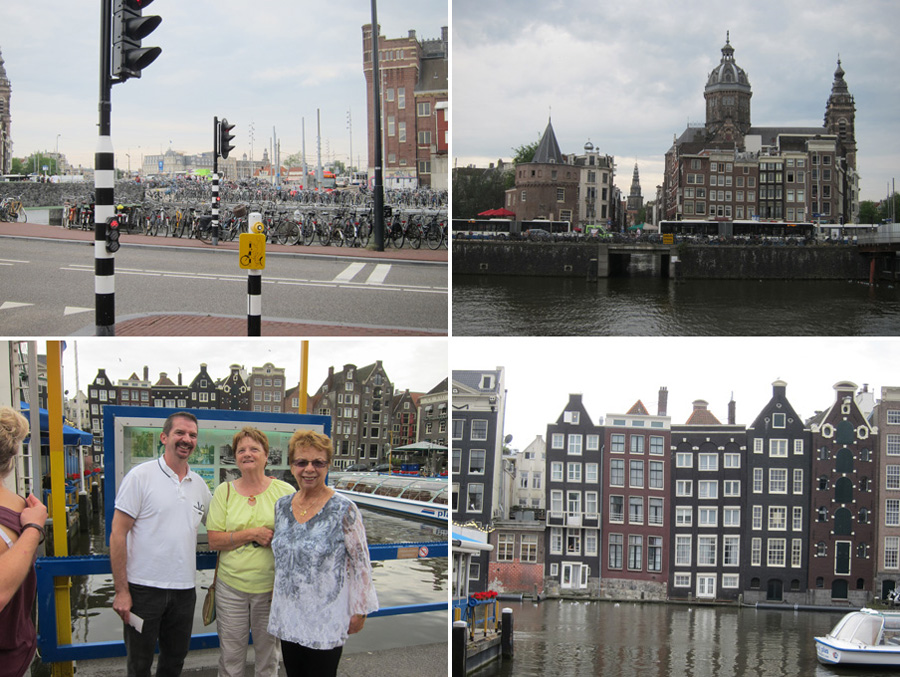
While on our walk about the city with Pete, we stopped for a canal sight seeing tour. I loved the bridges. In the photo above you can see through the bridge arch that there are several more bridges off in the distance. I think it might be fun to live in Amsterdam for a time.
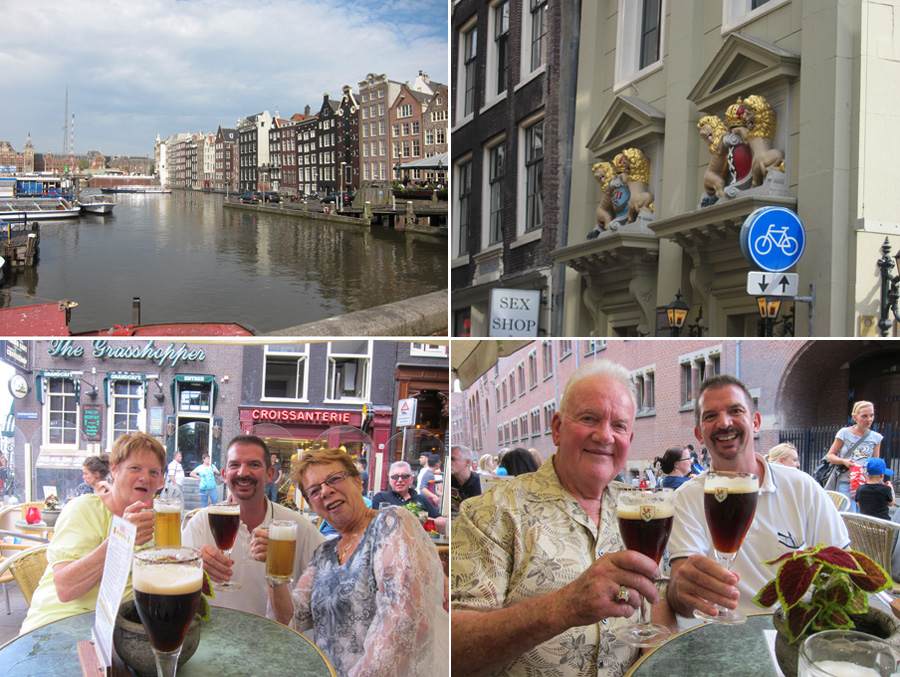
The cityscapes were beautiful, and of course what's a walk-about without a stop at a nice pub? It is summer after all, and we were feeling quite parched. Pat & Cindy liked the pilasters while Pete and I favored the dark beers.
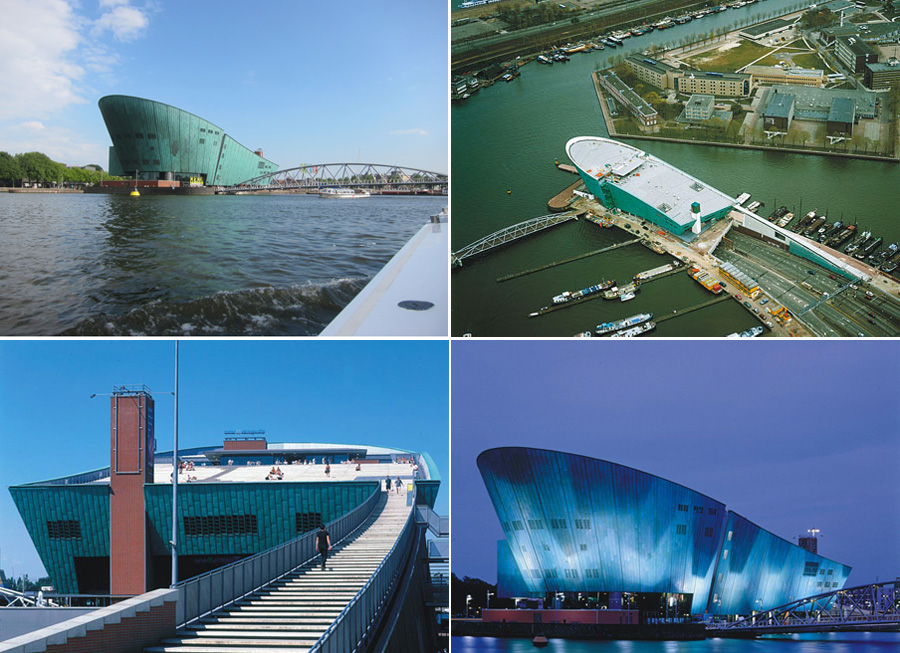
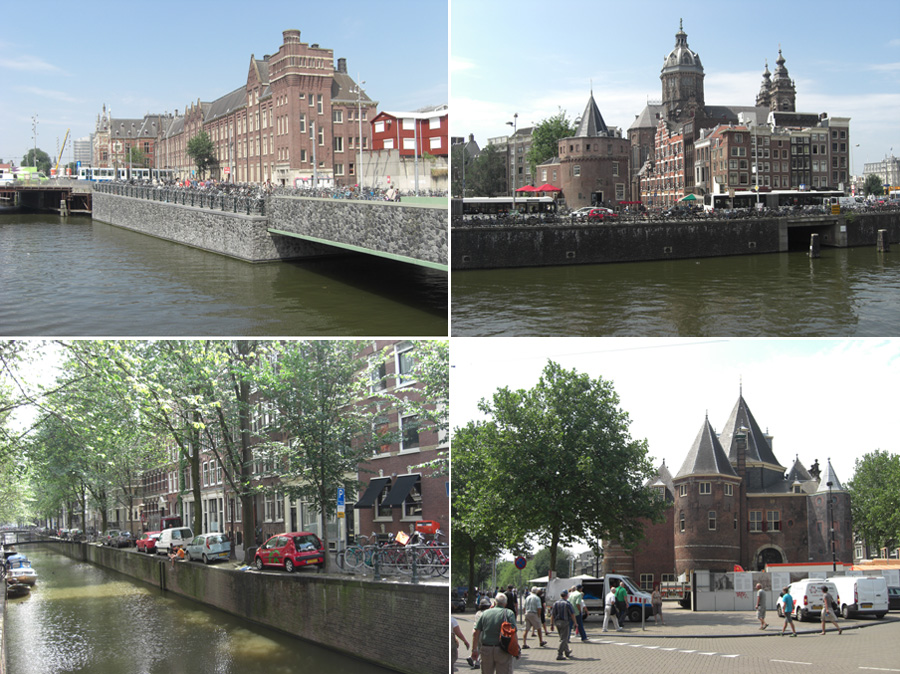
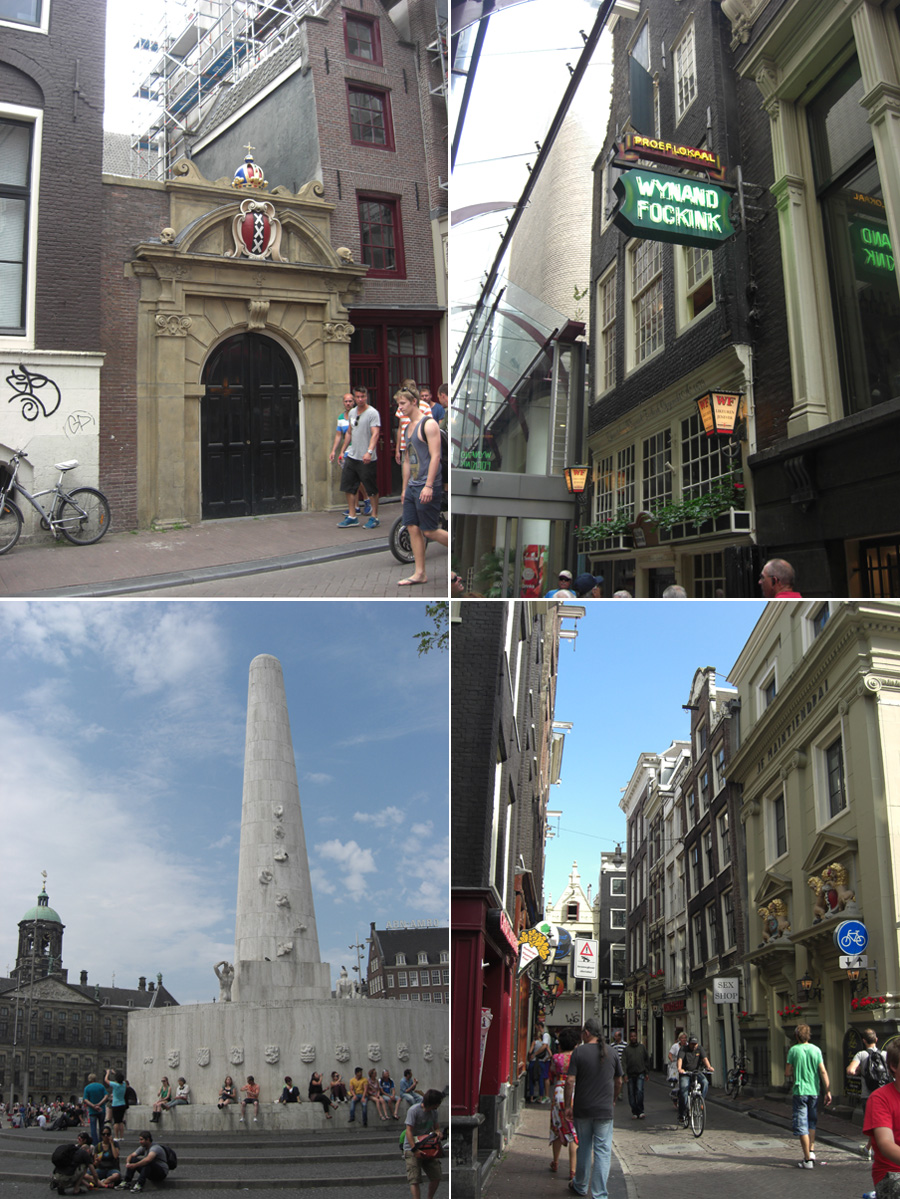
While on our canal sight seeing tour we came by this strange looking building. It is the science and technology museum, NEMO, and is situated on a small stretch of land in the port of Amsterdam, straddling the entrance to a road tunnel. Surrounded by water, the building has a ship-like form with a pre-oxidized copper-clad facade. A pedestrian ramp leads up onto the building's sloping roof that serves as a public piazza for visitors and as a social focus for the neighborhood. The night shot gives it an eery appearance. The following are photos Pete took on his city walking tour. I thought they were well worth sharing, to give you a more complete flavor of Amsterdam.
The canals remind me much of Venice in Italy, but they are mostly wider, and with fewer gondolas. The architecture
Parking ones car on the edge of a canal may be necessary due to the lack of parking garages, but I don't think I would
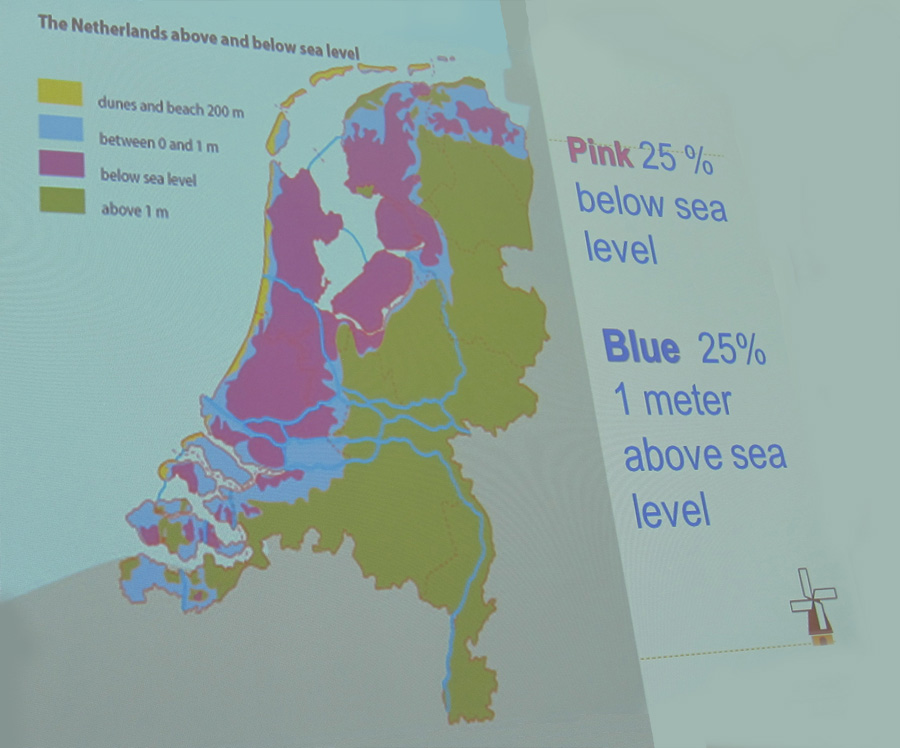
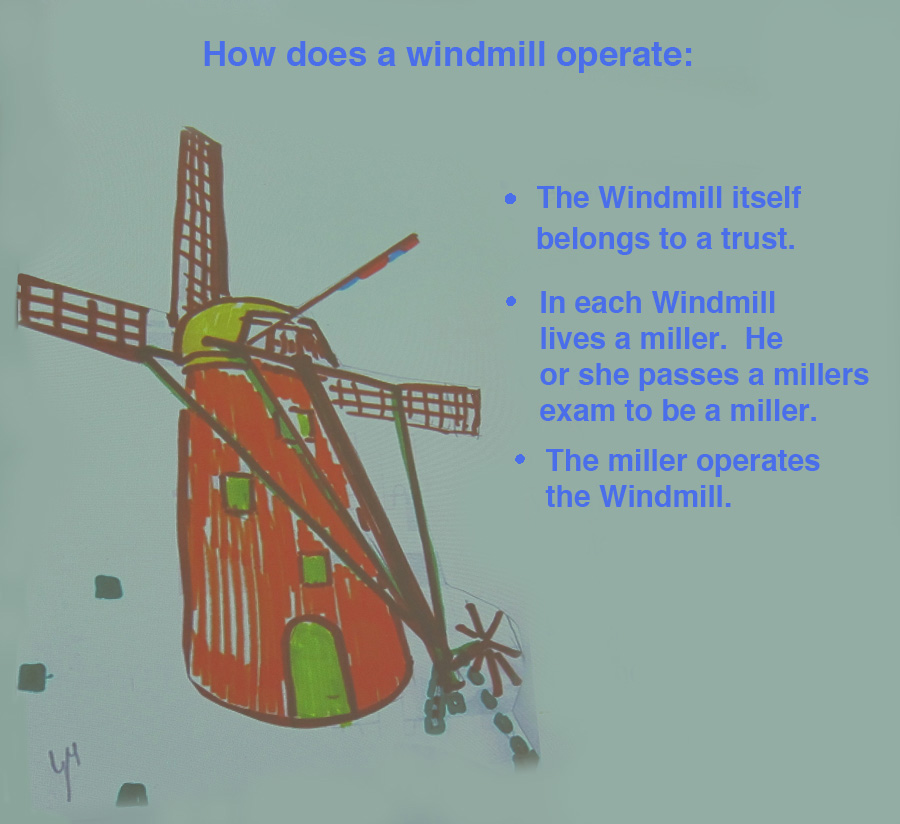
Narrow streets and constant walking on cobble stones make for very sore feet at the end of the day. I don't know The ship did in fact cast off at ll:30 PM and we headed for Kinderdijk, where we would be taking a shore excursion to visit the World Heritage site, with its network of windmills and ingenious flood management devices. Before we left the boat, a local spokesman came on-board and gave a brief but fascinating lecture on the windmills we would be visiting. For example, the Netherlands has been sinking for centuries. In the year 1000 water ran automatically into the rivers. In year 1500 the land is sunken by 5 feet, and in year 1700 the land is sunken by 10 feet. The country was slowly but surely sinking, and the land was being replaced by water.
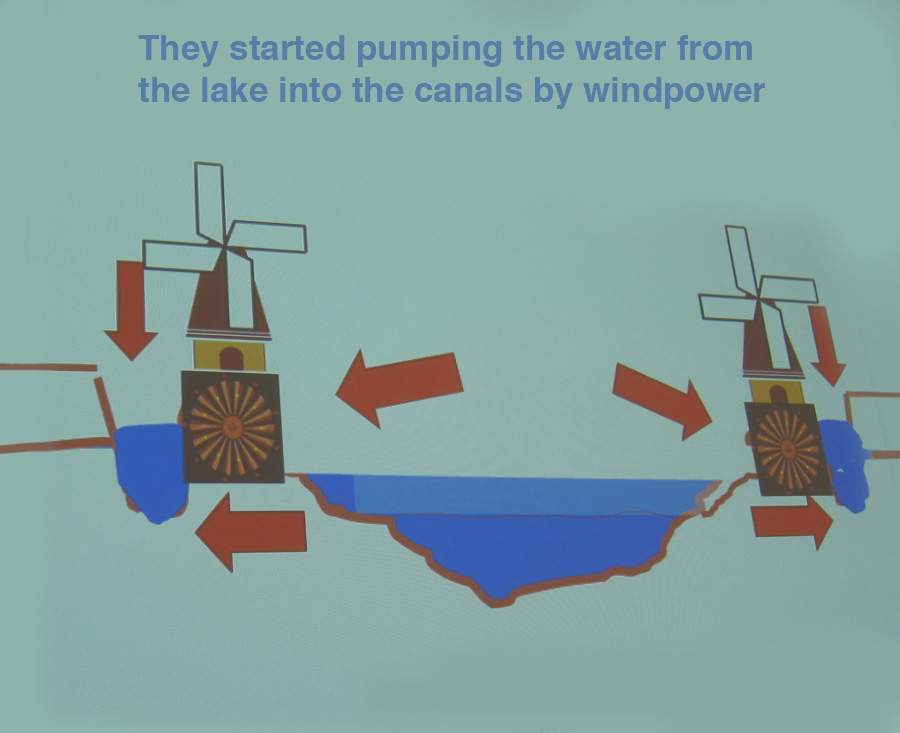
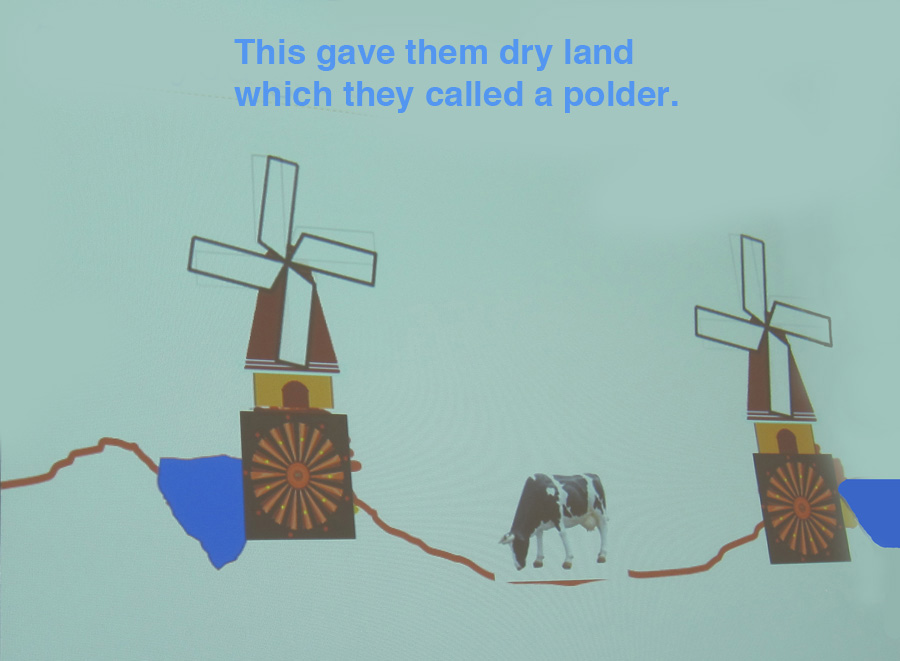
This map tells the tale. With 25% of the country below sea level, something had to be done. The ingenious Dutch began reclaiming the land in the 17th century, by building dikes and levees, and pumping the water off the land with the use of windmills and canals, they produced what they call polders.
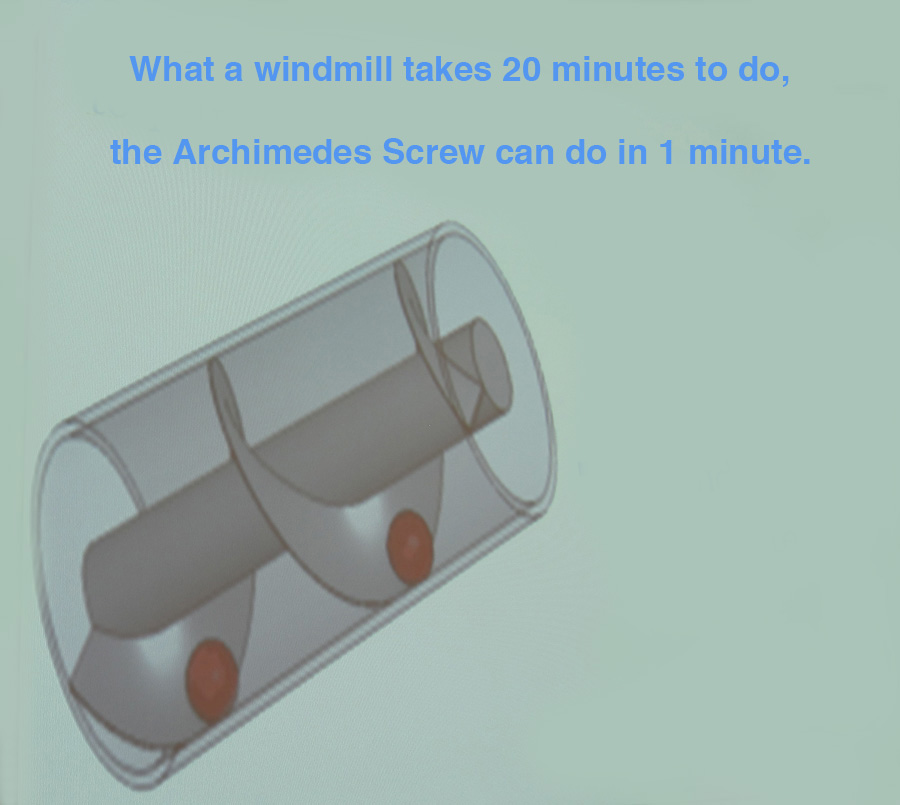
In modern times the windmills, although they are still maintained in an operational condition, they remain still, having been replaced by a much more efficient Archimedes Screw, which is powered by electricity produced by diesel generators.
If for some reason the diesel generators fail, the windmills are available as an emergency backup. The Dutch have a water board which coordinates the dikes and the canals. Every family pays a water tax of €430, and the Dutch spend €2 billion each year on water issues.
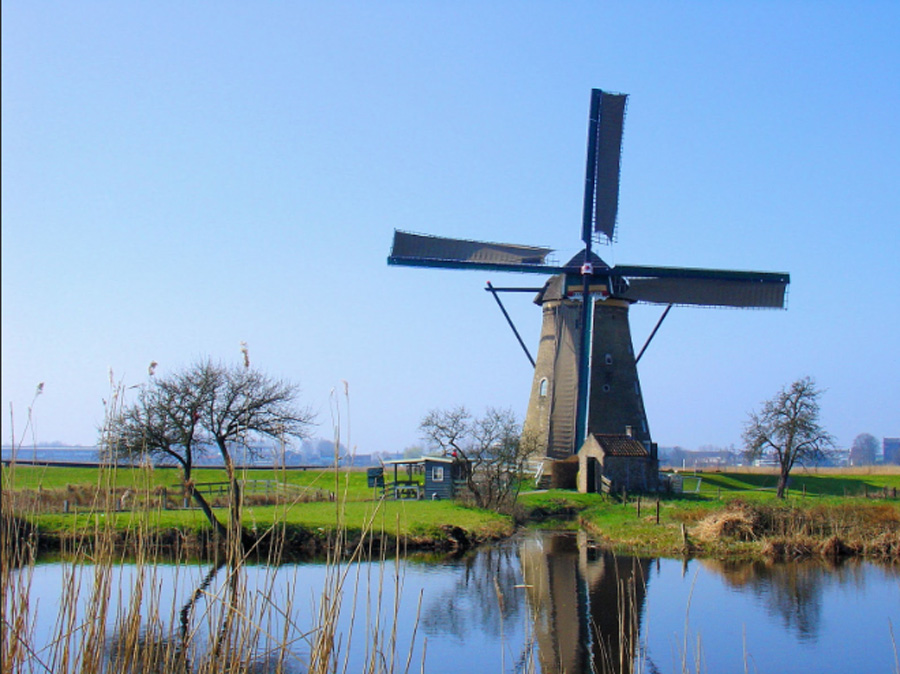
A windmill shown with it's sails unfurled.
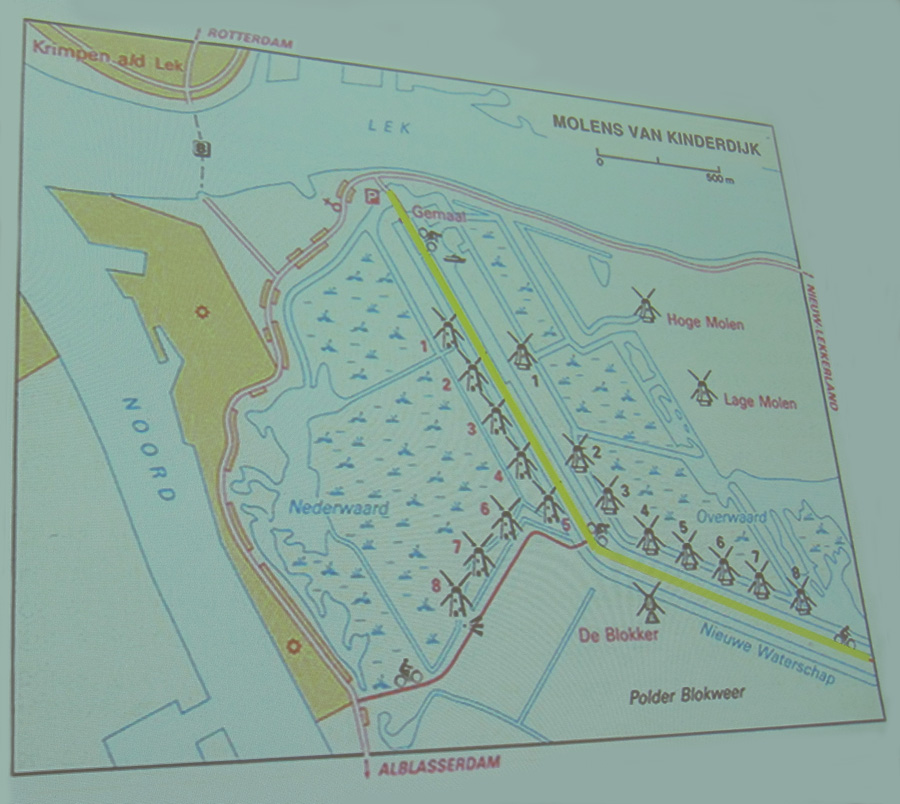
This is a rough map of the World Heritage site we visited at Kinderdijk which has 19 windmills.
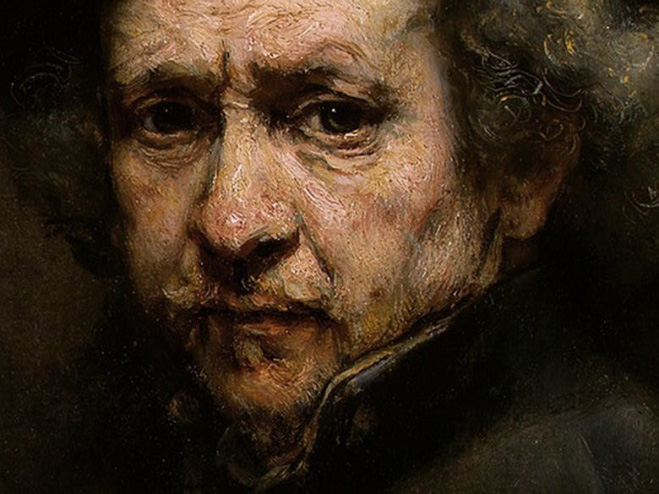
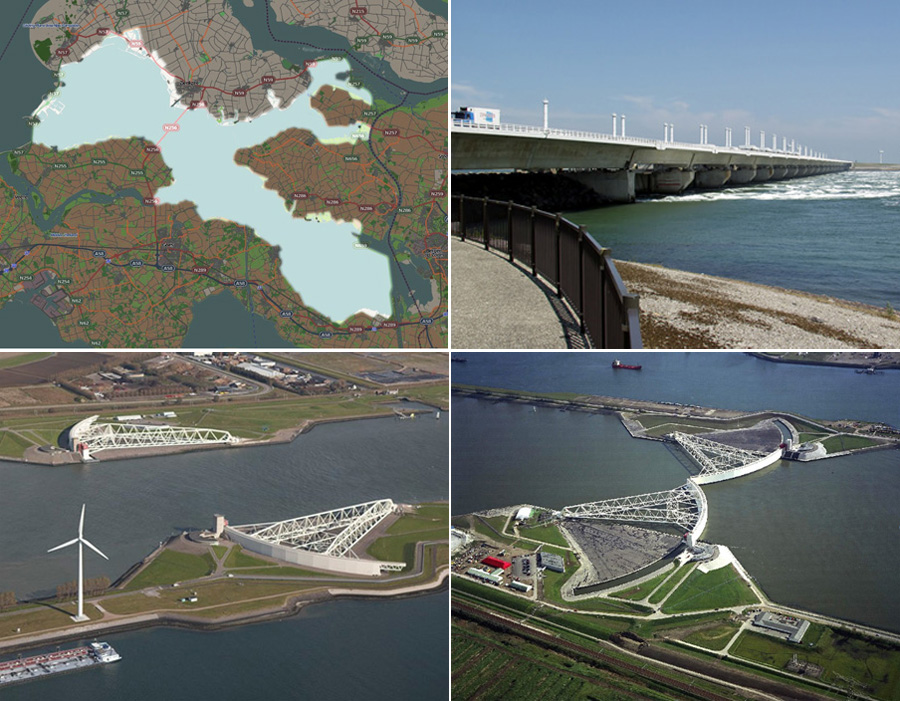
A famous son of a miller was the painter Rembrandt Harmenszoon van Rijn To give you an idea of the perils of living in a country with 25% of its land mass below sea level, there was an enormous tidal wave in 1953 which caused a break in the dikes and seawalls, in which 1,835 people were killed, and 500,000 were made homeless. Also, 10,000 animals drowned, and 4,500 buildings were destroyed. To avoid this from happening again, an ambitious flood defense system was conceived and deployed, called Delta Works.
These massive structures are engineering masterpieces, and protect the Oosterschelde estuary and delta from the massive The Dutch and their ancestors have been working to hold back and reclaim land from the North Sea for centuries. Over 2000 years ago, the Frisians who first settled the Netherlands began to build terpen, the first dikes to hold back the water. In 1287 the terpen and dikes that held back the North Sea failed, and water flooded the country. A new bay, called Zuiderzee (South Sea) was created over former farmland. For the next few centuries, the Dutch worked to slowly push back the water of the Zuiderzee, building dikes and creating polders (the term used to describe any piece of land reclaimed from water). Once dikes are built, canals and pumps are used to drain the land and to keep it dry. From the 1200s, windmills had been used to pump excess water off the fertile soil; today most of the windmills have been replaced with electricity- and diesel-driven pumps. Then came the storms and floods of 1916 providing the impetus for the Dutch to start a major project to reclaim the Suiderzee. From 1927 to 1932, a 19 mile long dike called Afsluitdijk (the Closing Dike) was built, turning the Zuiderzee into the IJsselmeer, a freshwater lake. (Much of the Netherlands is essentially a delta for the Rhine and other rivers.) Further protective dikes and works were build, reclaiming the land of the IJsselmeer. The new land led to the creation of the new province of Flevoland from what had been sea and water for centuries. The collective North Sea Protective Works is one of the Seven Wonders of the Modern World, according to the American Society of Civil Engineers. From the few photos above it is easy to see why. Today, approximately 27 percent of the Netherlands is actually below sea level. This area is home to over 60 percent of the country's population of 15.8 million people. This sounds like a disaster of epic proportions just waiting to happen. Think New Orleans and Katrina. The Netherlands, which is approximately the size of the states of Connecticut and Massachusetts combined, has an approximate average elevation of 11 meters (36 feet). The Netherlands ties Lemmefjord, Denmark for claim to the lowest point in Western Europe - Prince Alexander Polder lies at 23 feet (7 meters) below sea level. In PART 2 we will visit the World Heritage site at Kinderdijk and actually go inside one of the amazing windmills. |

|
|||
|