 |
|
|
|
|
|
|
|
|
|
|
||||||||
|
||||||||||||||||||
|
Email us at: |
||||||||||||||||||
 |
||||||||||||||||||
 |
 |
|||||||||||||||||
|
Click the sun to see the |
||||||||||||||||||



|
 |
|
|



|
|
||||||||||||||||||||||||||
|
It has been a fantastic cruise down the Volga River from Moscow to Volgograd, formerly known as Stalingrad during Soviet times.
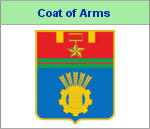
Volgograd Coat of Arms
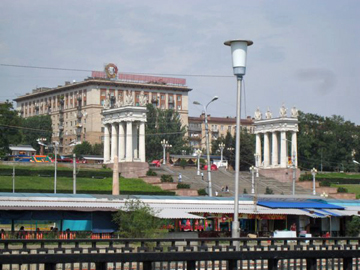
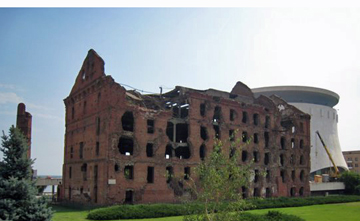
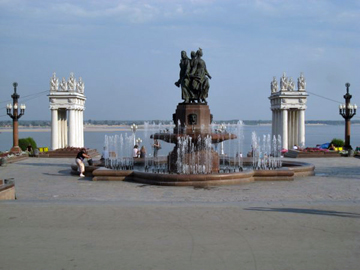
This is our first view of Volgograd, from the deck of the Lomonosov as we docked.
This turned out to be the most impressive port of our passage, at lease to me.
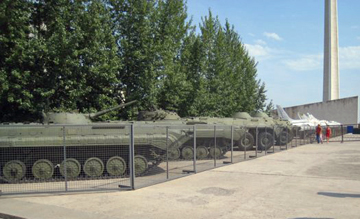
These are more war machines, relics of a never-to-be-forgotten war. NOTE: Much of the text that follows was given to us by our guide at this magnificent memorial commemorating the Battle of Stalingrad, but I was not able to take notes, so I've relied on Wikipedia, the free Internet encyclopedia, because I think the history is so important and interesting, and I wanted to get my facts straight. Please forgive the plagiarism.
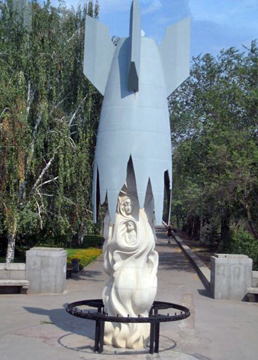
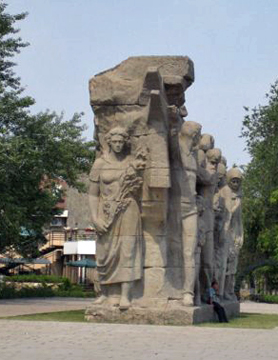
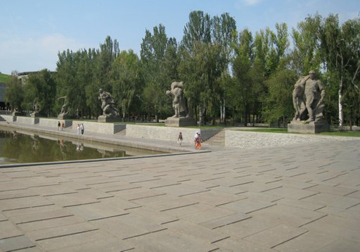
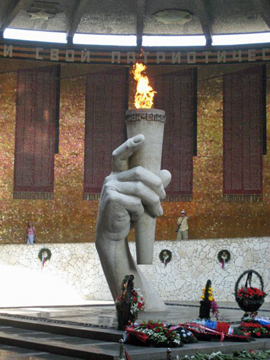
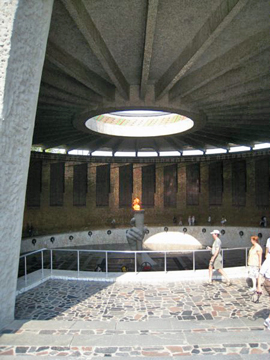
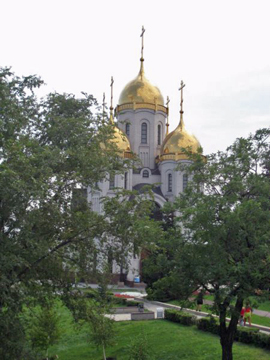
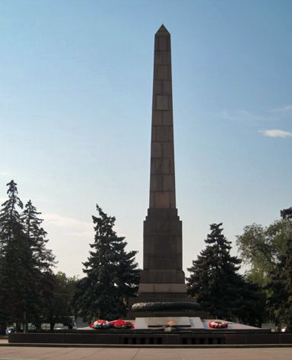
The Entrance Square contains pedestals filled with the holy soil from the hero-cities of USSR. This multifigured sculpture "Memory of the Generations" is an integral part of the people's procession with flowers, wreaths and half masted banners in honor of those who had fought for life and freedom. These next photos are of the memorial complex commemorating the Battle of Stalingrad (August 1942 to February 1943).
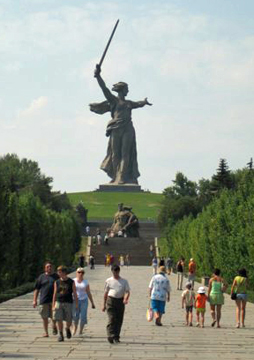
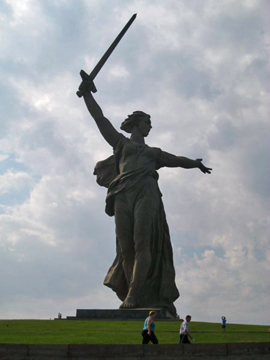
This photo, courtesy of Wikipedia, is taken from the base of the statue "The Motherland Calls!", which stands atop Mamayev Kurgan, a dominant height overlooking the city of Volgograd in southern Russia.
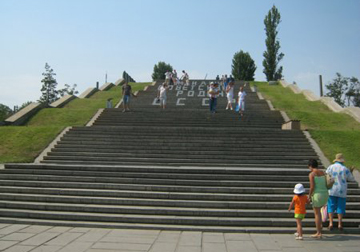
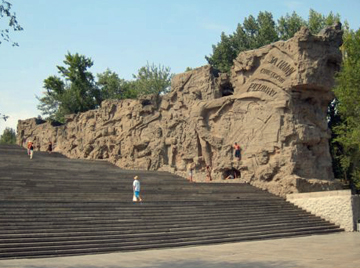
These steps lead up to the memorial site, an awesome complex that rivals any memorial in the world.
The statue is 82 meters tall (to the tip of the sword) and is called "The Motherland Calls!" It was the tallest statue in the world when erected in 1967. It is make of concrete, except for the 27 meter stainless steel sword. It was designed by Yevgeny Vuchetich.
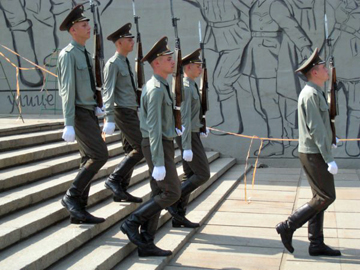
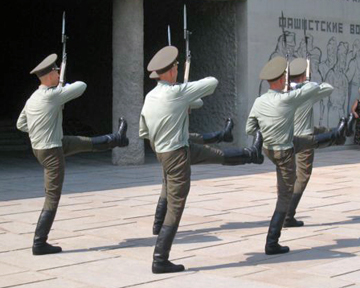
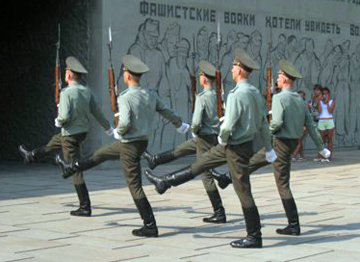
It was our great good fortune to have arrived at the memorial complex just at the time of the changing of the guard.
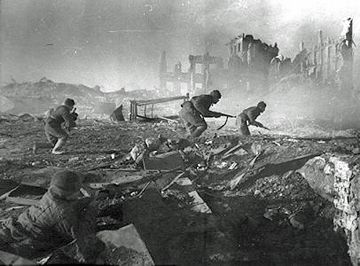
The battle was a decisive Soviet victory over Axis forces on the Eastern front of World War II and arguably the bloodiest battle in human history. When forces of the German 6th Army launched their attack against the city center of Stalingrad on 13 September 1942, Mamayev Kurgan (appearing in military maps as "Height 103.0") saw particularly fierce fighting between the German attackers and the defending soldiers of the Soviet 62nd Army. Control of the hill became vitally important, as it offered control over the city. To defend it, the Soviets had build strong defensive lines on the slopes of the hill, including trenches, barbed-wire and minefields. The Germans pushed forward against the hill, taking heavy casualties. When they finally captured the hill, they started firing on the city center, as well as on the railway station Stalingrad-1 under the hill. They captured the railway station on 14 September.
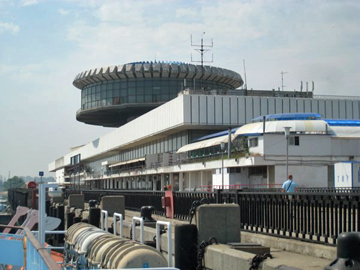
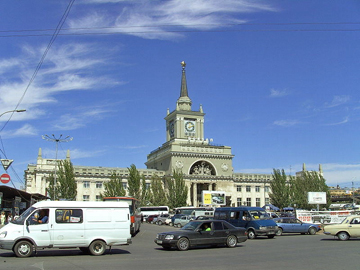
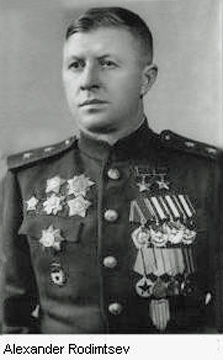
The Volgograd Train Station. On the same day, the Soviet 13th Guards Rifle Division commanded by Alexander Rodimtsev arrived in the city from across the river Volga under heavy German artillery fire.
The division's 10,000 men immediately rushed into the bloody battle. On 16 September they recaptured Mamayev Kurgan and kept fighting for the railway station, taking heavy losses. By the following day, almost all of them had died. The Soviets kept reinforcing their units in the city as fast as they could. The Germans assaulted up to twelve times a day, and the Soviets would respond with fierce counter-attacks. The hill changed hands several times. By 27 September 1942, the Germans had again captured half of Mamayev Kurgan. The Soviets held their own positions on the slopes of the hill, as the 284th Rifle Division desperately defended the key stronghold. The defenders held out until 28 January 1943, when the Soviet winter offensive relieved them, trapping and destroying the German forces inside Stalingrad. When the battle ended, the blood-soaked soil on the hill was churned by shellfire and mixed with metal fragments. The soil contained between 500 and 1,250 splinters of metal per square meter. The earth on the hill had remained black in the winter, as the snow kept melting in the many fires and explosions. In the following spring the hill would still remain black, as no grass grew on its scorched soil. The hill's formerly steep slopes had become flattened in months of intense shelling and bombardment. Even today it is possible to find fragments of bone and metal still buried deep throughout the hill.
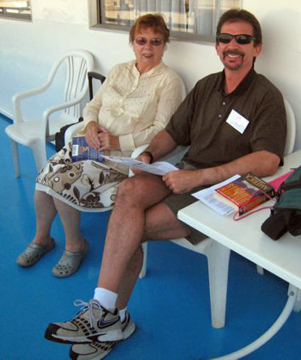
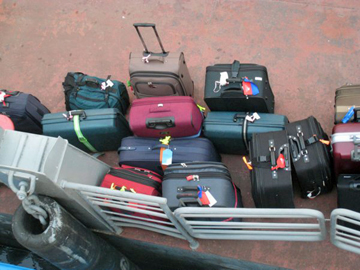
I was keeping tabs on our luggage, trying to make sure that it stayed together, and that it got on the bus with us.
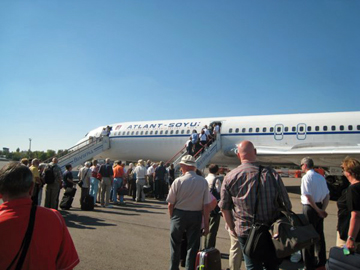
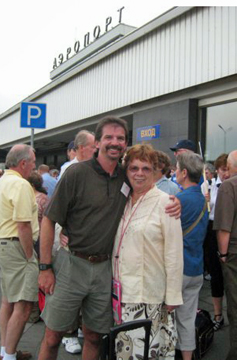
At the airport I snapped this photo, and immediately a woman came up to me and said that the taking of photographs was forbidden. Who knows why. We're just a bunch of tourists waiting to board our flight to St. Petersburg. It was very hot, and it took forever to board the plane. They would let 2 or 3 people enter the cabin door at a time, and waited until they were seated before they would allow another 2 or 3 to enter. It was probably the most inefficient way to board a plane I have ever experienced. Once on board, I discovered that the seats were so close together that there was no way to stretch your legs out under the seat in front of you. I had never experienced such cramped conditions, except when I was in survival training in the Navy, and while imprisoned in a simulated POW camp contrived by the Marines who ran this camp, to give us sailors an experience similar to what we might expect if we were to be captured by the enemy. Part of the training was to interrogate us, and part of that entailed a horrible stay in "the box", an enclosure so small that you had to enter and assume the fetal position so they could close the lid. Now that was a really tight situation. The seat on this plane brought back painful memories of that experience.
Our arrival in St. Petersburg was not very well coordinated. We had a long wait for thebus to arrive that would take our group to our hotel. Our experience with connections onour China Viking River Cruise tour was like a precision Swiss watch. Our Russian experience was more like a Timex with a battery that needed replacing. At least we had arrived, and we would be spending 3 days here in St. Petersburg. I was ready for a nice hotel experience, and what a great experience it was. The meals were provided, and the restaurant was excellent. The tours of the city were incredible, but I'll save that for Chapter 8. |

|
||||
|